



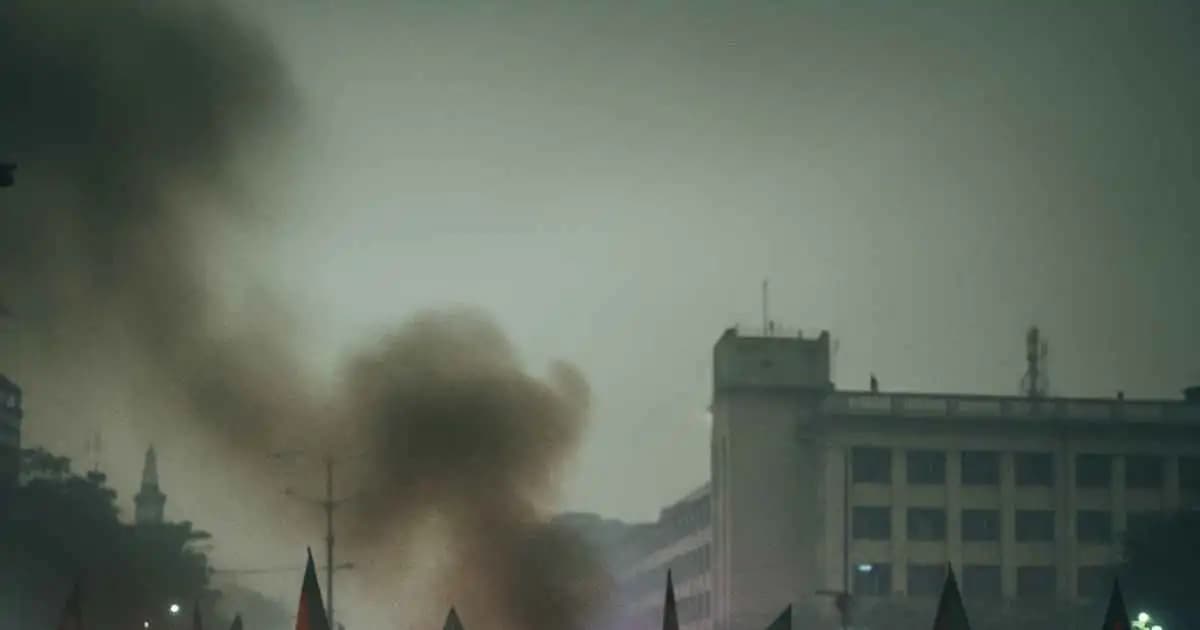
Bangladesh is once again confronting a familiar but deeply unsettling reality: political violence has returned at a moment when the country can least afford it. The killing of Sharif Osman Hadi, a young leader who emerged from the mass uprising of 2024, has triggered unrest that goes far beyond street protests. What is unfolding now is not just public anger over one death it is a stress test for Bangladesh’s fragile post uprising order, its institutions, and its regional relationships.
Hadi’s assassination has exposed unresolved fault lines left behind after the fall of Sheikh Hasina’s government. The scale of the reaction media offices torched, cultural institutions vandalised, diplomatic missions attacked signals that Bangladesh’s transition is entering a volatile phase, one that could define the road to the February 2026 national elections.
A Symbolic Figure in a Post Uprising Generation
Osman Hadi was not a conventional politician. At 32, he represented a new political class shaped by the 2024 uprising that forced Sheikh Hasina out of power and ended a long, polarising chapter in Bangladeshi politics. As a spokesperson for Inquilab Mancha, a socio cultural platform born from that movement, Hadi blended activism with electoral ambition something rare in Bangladesh’s traditionally party dominated landscape.
His decision to contest elections as an independent candidate from Dhaka 8 challenged both the old Awami League establishment and emerging power brokers within the interim political arrangement. That made him influential, but also vulnerable.
His killing during a campaign appearance public, brazen, and symbolic has been widely interpreted as an attempt to intimidate a generation that believed the uprising had opened the political system.
Why the Protests Escalated So Quickly
The intensity of the reaction following Hadi’s death cannot be Explained by grief alone. Bangladesh’s streets were already charged with unresolved anger, distrust, and political fatigue.
Several dynamics converged at once:
- A crisis of legitimacy: Many citizens remain unconvinced that post Hasina governance has delivered justice, accountability, or transparency.
- Fear of rollback: Hadi’s murder is seen by supporters as a warning to reformist voices entering formal politics.
- media distrust: Attacks on outlets like Prothom Alo and The Daily Star reflect long standing suspicions about elite narratives, foreign influence, and perceived proximity to India.
- Election anxiety: With national polls less than 14 months away, political actors are already positioning themselves sometimes violently.
The destruction of press offices is particularly alarming. A democracy emerging from upheaval depends on media credibility. Targeting journalists signals a breakdown in trust that goes beyond party lines.
Anti India Anger: Domestic Politics Meets Regional Tensions
One of the most consequential aspects of the unrest has been its explicit anti India tone. Demonstrations outside Indian diplomatic missions in Dhaka and Chattogram underscore how deeply foreign policy grievances have seeped into domestic politics.
India’s decision to host Sheikh Hasina after her ouster remains a lightning rod. For many protesters, Hadi’s killing has become intertwined with broader resentment toward Delhi’s perceived influence over Bangladeshi politics.
This mirrors a global pattern where domestic political crises spill into foreign relations much like how immigration debates in the U.S. often escalate after violent incidents, as seen in the suspension of the green card lottery following a high profile crime (explained in detail).
For Bangladesh, the risk is clear: prolonged unrest could harden public sentiment against India, complicating trade, Security cooperation, and regional stability.
Media, Memory, and the Politics of Symbols
The repeated vandalism of Sheikh Mujibur Rahman’s residence already attacked multiple times since last year is another signal that history itself is under contestation. Mujibur Rahman is both the founding father of the nation and a deeply polarising symbol due to his association with the Awami League and his daughter’s rule.
When symbols become targets, politics stops being about policy and starts becoming about identity. That is often the most dangerous stage of political unrest.
This echoes other governance crises where public trust erodes gradually and then collapses suddenly whether through environmental failures like Delhi’s air pollution enforcement battles or public health neglect that forces citizens to rely on traditional remedies for chronic problems. In all cases, institutional credibility is the real currency at stake.
Yunus’ Promise and the Test Ahead
Chief Adviser Muhammad Yunus’ televised address struck the right tone: restraint, justice, and institutional process. But words alone will not calm a country on edge.
What matters next is action, particularly in three areas:
- Credible investigation: Any perception of delay or political shielding will inflame tensions.
- Protection of institutions: Media houses, cultural organisations, and diplomatic missions must be safeguarded to prevent further escalation.
- Political inclusion: Reformist voices must be allowed to participate safely in the electoral process.
Failure in any of these areas risks normalising political violence once again.
What Happens Next and Why It Matters Beyond Bangladesh
Bangladesh’s stability matters far beyond its borders. As one of South Asia’s most populous nations, any prolonged unrest affects Regional trade routes, migration patterns, and diplomatic alignments.
If Hadi’s death becomes a turning point that discourages youth participation in politics, the long term cost will be generational. If it leads to genuine accountability and reform, it could strengthen Bangladesh’s democratic foundations.
At this moment, the country stands between two paths: one leading toward institutional renewal, the other back to cycles of repression and revolt.
The direction it chooses will shape not just the 2026 elections, but the political character of Bangladesh for years to come.
Related article: When Celebration Turned Silent: Bondi Beach and a Community in Mourning