



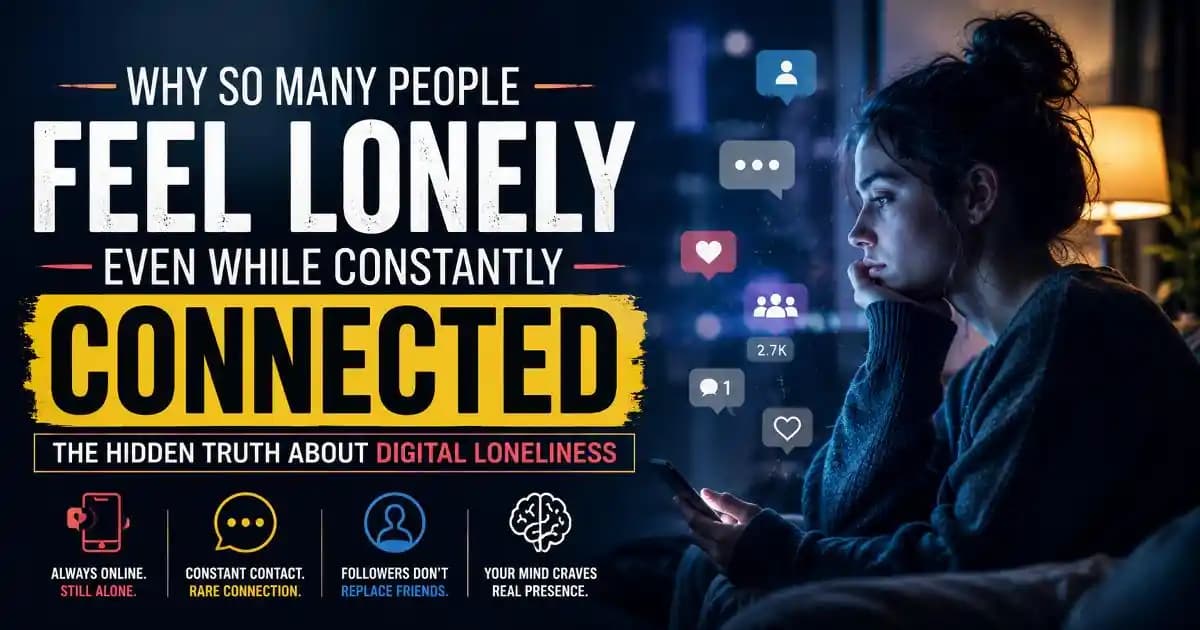
Loneliness in digital age often feels confusing because many people are technically connected almost all the time. Notifications arrive constantly. Group chats stay active. Social feeds never stop moving. People exchange memes, reactions, videos, voice notes, and updates throughout the day.
And yet a growing number of people still go to bed feeling emotionally unseen.
That contradiction has quietly become one of the defining emotional experiences of modern internet culture.
Many people are no longer isolated in the traditional sense. They are socially surrounded but emotionally undernourished. They interact constantly while struggling to feel deeply connected to anyone for very long.
The emotional exhaustion this creates can feel difficult to explain because digital communication creates the appearance of closeness even when genuine emotional intimacy is missing.
For a lot of people, loneliness no longer looks like physical solitude. It looks like staring at a glowing screen full of conversations while still feeling emotionally disconnected inside.
Why online connection does not always feel emotionally real
Human beings are emotionally shaped by presence.
Not just information exchange. Not just interaction frequency. Presence.
Real emotional connection often depends on slower psychological experiences: eye contact, attention, emotional tone, pauses in conversation, physical closeness, emotional safety, shared silence, and feeling psychologically noticed.
Digital communication compresses many of those emotional signals into faster, smaller interactions.
People can now maintain dozens of ongoing social connections while rarely experiencing emotionally sustained conversation.
This is partly why many users describe feeling strangely empty after spending hours online. The brain receives constant social stimulation but not always enough emotional fulfillment.
Social interaction and emotional intimacy are not the same thing.
Modern platforms are extremely effective at keeping people socially engaged. They are often much less effective at helping people feel emotionally grounded.
The attention economy changed how people communicate
The attention economy quietly reshaped communication itself.
Conversations increasingly compete against notifications, algorithmic feeds, short-form content, AI-generated entertainment, work messages, and constant digital interruption.
As a result, attention became fragmented.
Many people now communicate while partially distracted most of the time.
Someone responds to messages while scrolling videos. Someone listens during a conversation while checking notifications. Someone spends time with friends while mentally drifting toward content feeds.
This weakens emotional depth slowly rather than dramatically.
People remain socially reachable but psychologically divided.
Over time, relationships can start feeling emotionally thinner because sustained attention one of the core ingredients of intimacy becomes harder to maintain consistently.
Why social media can intensify loneliness
Social media creates emotional paradoxes that the human brain did not fully evolve to handle.
People are constantly exposed to other people’s friendships, relationships, celebrations, vacations, achievements, inside jokes, and emotionally curated lives.
Even when users intellectually understand that online content is selective and edited, the emotional brain still absorbs comparison signals.
Someone scrolling alone at night may suddenly feel emotionally excluded from a world that appears socially vibrant everywhere else.
This can create a subtle form of loneliness driven less by physical isolation and more by perceived emotional distance from others.
Modern loneliness often grows through comparison as much as separation.
And because algorithms prioritize emotionally engaging content, people are repeatedly shown idealized social moments that intensify feelings of being left behind emotionally.
Many people now confuse visibility with connection
Online culture also changed how people emotionally interpret attention itself.
Being visible online can temporarily feel like connection because likes, replies, views, and reactions trigger social recognition.
But recognition is not always intimacy.
A person can receive hundreds of interactions online while privately feeling unknown.
This emotional gap explains why many creators, influencers, remote workers, and highly online individuals sometimes describe intense loneliness despite constant digital engagement.
The internet makes people visible to more individuals than ever before while often reducing opportunities for emotionally grounded connection.
Visibility satisfies social stimulation temporarily. Emotional closeness requires something slower and more vulnerable.
Digital life increased emotional self-consciousness
Many people now experience relationships through a layer of constant self-awareness created by online culture.
People think about how conversations appear. How relationships look publicly. How emotionally expressive they should seem. How quickly they should reply. How visible their social lives appear online.
This can create emotional performance pressure inside relationships themselves.
Instead of simply experiencing connection, people sometimes monitor connection from the outside while it is happening.
That psychological self-monitoring makes emotional presence harder.
The more people become accustomed to performing identity online, the harder it can become to fully relax emotionally around others offline.
Why remote life changed emotional rhythms
Remote work culture and digitally mediated lifestyles also changed how people experience everyday human interaction.
Many adults now spend large portions of life communicating through screens instead of shared physical environments.
Meetings happen online. Friendships continue through messaging apps. Dating starts through algorithms. Communities form digitally. Entertainment becomes personalized and isolated.
These systems offer convenience and flexibility. But they also reduce many spontaneous forms of human connection that once existed naturally in physical life.
Casual conversations, shared environments, repeated face-to-face interactions, and unplanned emotional moments all helped create social familiarity historically.
Modern life increasingly requires people to intentionally create connection instead of naturally encountering it.
That emotional shift can feel surprisingly lonely.
AI-generated culture is making emotional authenticity harder to recognize
The rise of AI-generated content adds another layer to modern loneliness.
People now scroll through feeds filled with synthetic influencers, AI-generated images, artificial emotional storytelling, automated conversations, and highly optimized digital personalities.
This changes how people emotionally interpret authenticity online.
Many users increasingly feel uncertain about what is emotionally real versus algorithmically manufactured.
That uncertainty quietly affects trust.
And emotional trust is one of the foundations of meaningful connection.
When digital environments feel emotionally artificial for long periods, people can begin craving deeper forms of human presence even more intensely.
The nervous system still needs real emotional closeness
One reason loneliness feels so emotionally heavy today is because human beings remain biologically wired for genuine social bonding despite technological change.
The nervous system still responds deeply to feeling emotionally understood, physically safe, and psychologically present with other people.
No amount of constant content fully replaces that need.
This is partly why many people feel emotionally calmer after experiences that involve sustained presence: long conversations without phones, shared meals, walking with friends, honest emotional vulnerability, eye contact, physical affection, and moments where attention feels undivided.
These experiences slow the nervous system down in ways digital interaction often cannot fully replicate.
Modern loneliness is often quiet rather than dramatic
Loneliness in digital age rarely matches the older stereotype of complete isolation.
More often, it appears quietly.
It appears in conversations that feel emotionally surface-level. In constantly checking phones for connection. In scrolling during moments of emptiness. In feeling socially replaceable. In struggling to feel emotionally present. In realizing that endless interaction still does not create enough closeness.
Many people are not lacking contact. They are lacking emotional depth, psychological stillness, and relationships where attention feels fully present.
That distinction matters.
Why more people are finally talking about digital loneliness
A growing number of people are beginning to recognize that modern loneliness is deeply connected to how digital life reshaped attention, communication, relationships, and emotional rhythms.
Not because technology is inherently harmful. And not because online connection has no value.
Digital spaces genuinely help people maintain relationships, find communities, express identity, and access emotional support.
But many are starting to realize that constant connection alone is not enough for emotional wellbeing.
Human beings still need moments of undistracted presence, emotional safety, honest vulnerability, and relationships that feel psychologically real instead of endlessly performative.
And for many people, recognizing that truth is the first step toward understanding why they can feel surrounded by interaction online while still quietly feeling alone inside.