


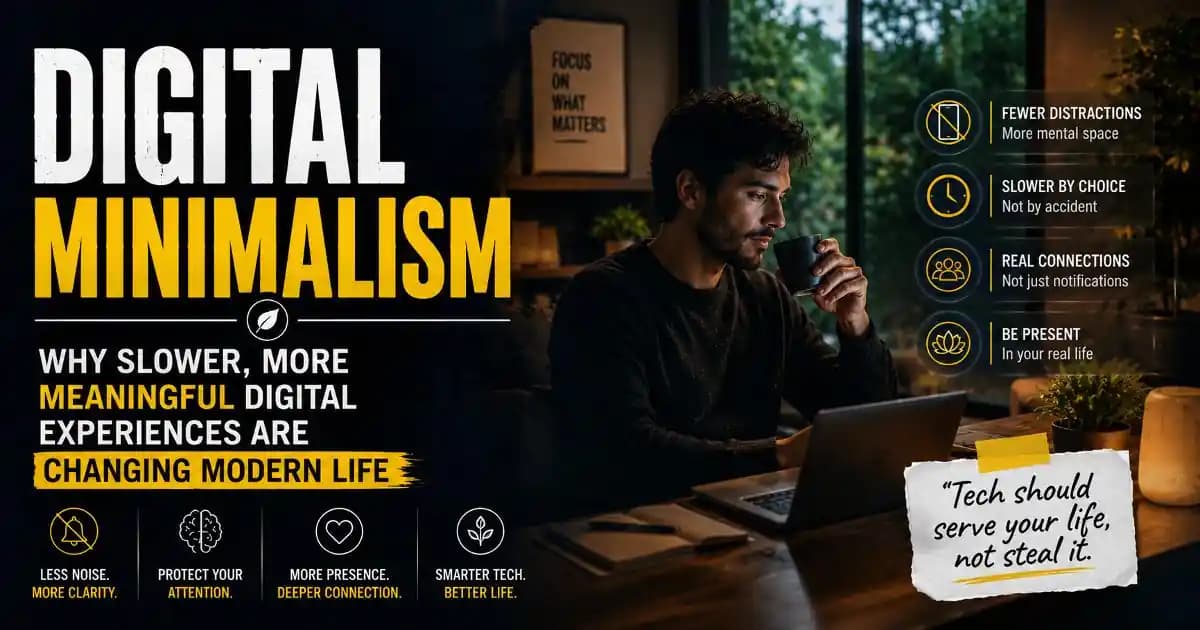
Digital minimalism increasingly feels less like a productivity trend and more like an emotional reaction to how exhausting online life has quietly become.
Someone deletes social media apps for a weekend and notices an unfamiliar mental calmness returning slowly. Another person starts preferring long-form conversations over endless short videos. Someone else realizes they no longer want more content, more updates, more platforms, or more notifications. They simply want their attention to feel quieter again.
This emotional shift is happening quietly across modern internet culture.
Many people are beginning to feel emotionally overwhelmed by the speed, noise, and constant stimulation built into digital life. The issue is not necessarily that technology itself feels bad. It is that modern online environments increasingly demand continuous attention without offering enough emotional depth in return.
For years, internet culture rewarded speed, visibility, instant reaction, constant updates, algorithmic engagement, and endless content consumption.
Now many individuals are starting to emotionally crave the opposite.
Slower experiences. More intentional attention. Smaller digital spaces. Less performance. Fewer interruptions. More emotional clarity.
What people increasingly want is not complete disconnection from technology. It is a healthier emotional relationship with it.
Why digital life started feeling emotionally exhausting
Modern digital environments evolved around maximizing engagement.
Social media platforms, creator ecosystems, AI-powered feeds, productivity apps, streaming systems, and algorithmic recommendation engines all compete constantly for attention.
The result is an online culture where the nervous system rarely fully rests.
People move rapidly between notifications, messages, videos, opinions, trends, advertisements, online arguments, productivity pressure, and endless streams of emotionally stimulating content.
Even moments meant for relaxation often become forms of overstimulation.
Someone scrolls to unwind but finishes feeling mentally crowded instead. Another person watches short-form content for an hour and notices they feel emotionally restless afterward without fully understanding why.
This happens partly because the brain was never designed to process nonstop digital stimulation continuously.
The nervous system eventually becomes fatigued by constant attentional switching, emotional interruption, and information overload.
Many people now describe feeling mentally full long before they feel emotionally satisfied.
Digital minimalism reflects emotional self-protection
One reason digital minimalism resonates emotionally now is because many individuals no longer experience online life as emotionally neutral.
Digital environments increasingly shape mood, attention, identity, relationships, self-worth, emotional regulation, and mental clarity every day.
As overstimulation grows, some people naturally begin protecting themselves psychologically by reducing digital noise intentionally.
This is not always dramatic.
Sometimes it looks like turning off notifications. Spending less time scrolling. Preferring smaller online communities. Listening to podcasts while walking instead of consuming rapid-fire content feeds. Choosing slower forms of media. Leaving platforms that feel emotionally draining.
Often the emotional motivation is not discipline.
It is exhaustion.
People are beginning to realize that constant connectivity does not automatically create emotional fulfillment.
The attention economy made online experiences feel shallow
The attention economy rewards content that captures focus quickly.
As a result, much of modern internet culture became optimized around speed, novelty, emotional intensity, and endless engagement loops.
Short-form videos, algorithmic feeds, rapid scrolling, click-driven headlines, outrage cycles, emotional performance, and constant visibility dominate many online spaces because they hold attention efficiently.
But emotionally, endless stimulation often creates a strange emptiness.
People consume huge amounts of content without feeling deeply connected to much of it.
Conversations become fragmented. Attention becomes reactive. Emotional processing becomes interrupted continuously by the next piece of stimulation.
Many individuals quietly notice they spend hours online while feeling increasingly disconnected from themselves afterward.
This emotional dissatisfaction partly explains why slower digital experiences now feel more meaningful.
Why slower online spaces feel emotionally calming
People increasingly feel emotionally drawn toward online experiences that create less pressure and more attentional stability.
Long-form writing, thoughtful podcasts, slower YouTube essays, smaller online communities, intentional newsletters, quiet digital spaces, and meaningful conversation formats often feel emotionally different from fast-moving algorithmic feeds.
The nervous system reacts differently when attention no longer needs to switch constantly.
People feel more mentally present.
Thoughts unfold more naturally. Emotional reactions become less fragmented. Reflection feels easier. Conversations feel more human again.
This is one reason many individuals now describe certain slower digital experiences as emotionally restorative instead of emotionally draining.
The internet itself is not the problem entirely. The emotional structure of how attention gets managed online matters deeply.
Social media changed how people emotionally experience themselves
Part of the emotional exhaustion surrounding digital life comes from how online culture reshaped identity and self-perception.
Social platforms increasingly encourage people to remain visible, responsive, interesting, productive, emotionally engaging, and socially relevant at all times.
Life gradually becomes partially performative.
People think about how experiences appear online while living them. Validation becomes measurable through likes, reactions, comments, shares, and visibility metrics.
Eventually, many individuals begin feeling emotionally tired from constant self-monitoring.
This is partly why digital minimalism often feels emotionally relieving. It reduces the psychological pressure of being continuously visible and emotionally available inside algorithmic environments.
Some people are not leaving certain online spaces because they hate technology. They are leaving because they miss feeling mentally present inside their own lives.
AI-generated content is accelerating digital exhaustion
The rise of AI-generated content is intensifying the emotional desire for slower digital experiences even further.
People now consume enormous amounts of highly optimized content created to maximize engagement, emotional reaction, and retention. AI systems accelerate content production faster than human attention can emotionally process comfortably.
The internet increasingly feels infinite.
There is always more to consume, more to respond to, more to optimize, more to compare against, and more to emotionally absorb.
For many people, this creates psychological fatigue rather than excitement.
Some individuals now feel emotionally drawn toward content and communities that feel more human, slower, imperfect, intentional, and less algorithmically engineered.
They crave experiences that feel emotionally grounding instead of endlessly stimulating.
Why people are romanticizing older internet culture again
Many people increasingly feel nostalgic for earlier internet experiences not necessarily because older technology was objectively better, but because online life once felt slower and psychologically smaller.
People spent more time exploring intentionally instead of being endlessly pushed through engagement loops by algorithms. Online spaces often felt more community-driven and less performative.
There were fewer notifications. Less pressure to remain constantly visible. Fewer systems competing aggressively for emotional attention.
This nostalgia reflects a deeper emotional craving for digital experiences that feel less overwhelming and more emotionally manageable.
People increasingly miss the feeling of choosing attention instead of constantly defending it.
Digital minimalism is not about rejecting modern life
One misunderstanding around digital minimalism is the assumption that it means rejecting technology completely.
Most people are not trying to disappear offline entirely.
They still use AI tools, streaming platforms, digital communication, remote work systems, creator content, and social apps. The emotional shift happening now is more nuanced.
People increasingly want technology that supports human wellbeing instead of continuously overwhelming attention.
They want online experiences that feel intentional rather than addictive.
They want communication without permanent urgency. Entertainment without emotional overload. Connection without constant performance.
Digital minimalism reflects a growing awareness that attention itself shapes emotional life.
And many people no longer want all of their attention controlled by systems designed primarily around engagement.
Why meaningful attention now feels emotionally valuable
As digital overstimulation grows, uninterrupted attention begins feeling emotionally rare.
People increasingly value experiences where they can focus deeply without fragmentation: long conversations, meaningful reading, creative work, intentional relationships, slower entertainment, quiet reflection, and emotionally grounded online communities.
These experiences feel psychologically nourishing because they allow the nervous system to settle instead of remaining continuously reactive.
For many individuals, the emotional appeal of digital minimalism is ultimately about reclaiming mental clarity.
It is about wanting fewer interruptions between thoughts.
Fewer demands for emotional reaction.
Fewer algorithmic pressures shaping identity, mood, and attention invisibly throughout the day.
People increasingly want room to think clearly again.
Human beings still need emotional spaciousness
The deeper reason slower digital experiences feel so emotionally appealing now is because human psychology still depends on emotional spaciousness.
The nervous system needs moments without constant stimulation, comparison, interruption, performance, or emotional overload.
Without enough of those experiences, attention becomes fragmented and emotional exhaustion quietly accumulates.
Modern internet culture spent years accelerating speed, visibility, optimization, and endless engagement.
Now many people are beginning to realize that faster does not always feel better emotionally.
Sometimes what the mind truly wants is not more information, more content, or more stimulation.
Sometimes it simply wants enough quiet attention to feel emotionally connected to life again.