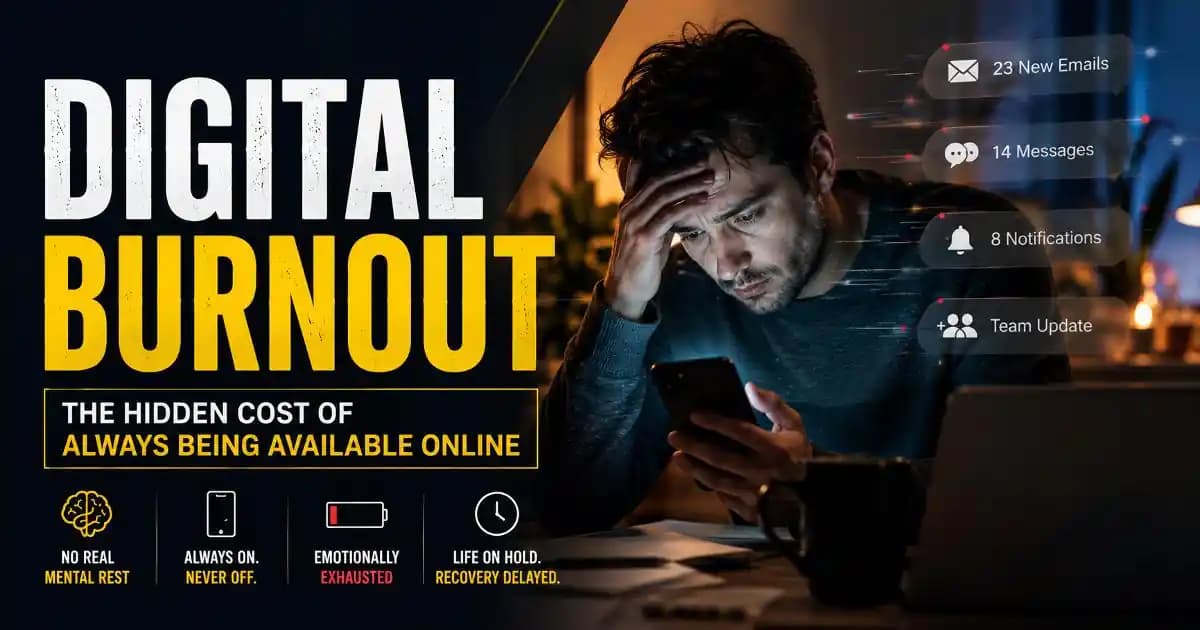



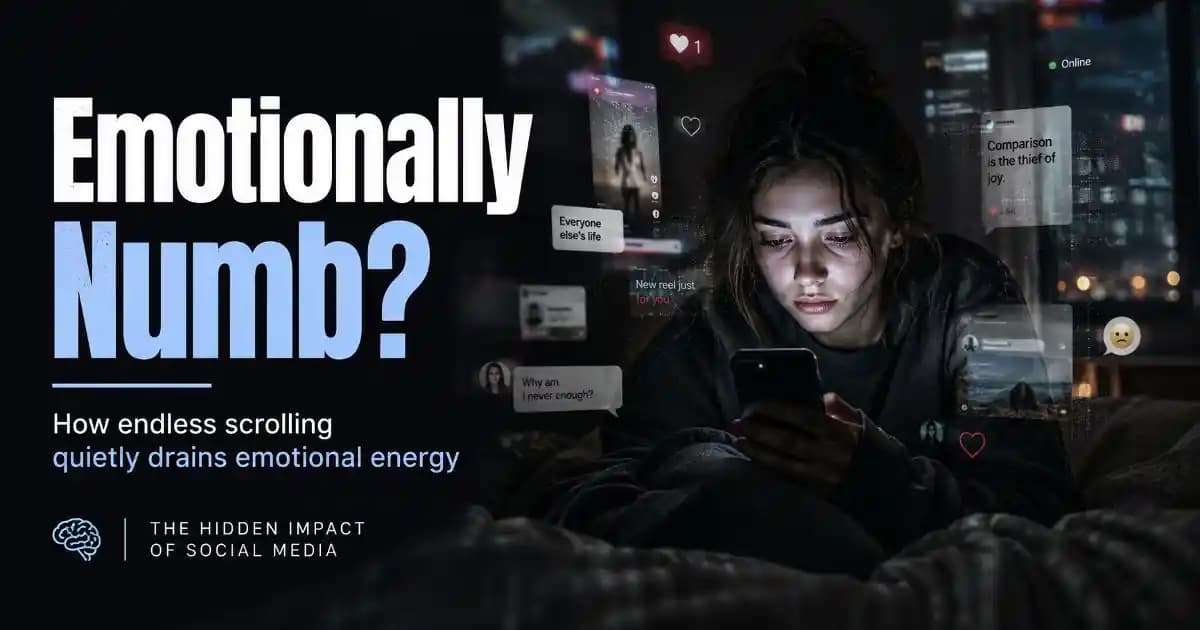
Why so many people feel emotionally numb after constant social media use has become one of the defining emotional experiences of modern internet life. A person can spend hours online every day laughing at memes, watching emotional videos, reading arguments, scrolling through tragedies, liking photos, replying to messages and still end the night feeling strangely disconnected from themselves.
Not sad exactly. Not even overwhelmed in an obvious way. Just emotionally flat.
A lot of people quietly notice this happening after long periods of constant scrolling. Their attention still works. Their routine still functions. But emotions start feeling distant, delayed, or harder to access. Things that once felt exciting barely register. Conversations feel thinner. Rest feels less restorative. Even moments of happiness can feel muted, like the brain never fully arrives emotionally.
This emotional numbness is becoming deeply tied to how modern Digital platforms shape attention, stimulation, and emotional processing.
Social media keeps the nervous system constantly active
Most social media platforms were never designed around emotional recovery. They were designed around engagement.
The average person now consumes hundreds of emotional signals in a single day online. A few minutes of scrolling can include:
• someone announcing an engagement
• a creator talking about burnout
• political outrage
• relationship advice
• a tragic news clip
• luxury lifestyle content
• AI-generated entertainment
• a nostalgic childhood video
• productivity guilt
• a celebrity scandal
• a mental health confession
The brain receives all of these emotional inputs almost instantly, often without time to process any of them fully.
Human emotions were never built for this level of rapid emotional switching.
In offline life, emotional experiences usually unfold with context, pacing, and physical grounding. Online, emotions arrive compressed into seconds. People move from grief to humor to fear to envy within minutes.
Over time, the nervous system adapts by lowering emotional responsiveness altogether.
This is one reason digital overstimulation can slowly create emotional numbness. The brain begins protecting itself from constant intensity by emotionally flattening the experience.
Endless scrolling weakens emotional presence
One of the strangest effects of modern scrolling culture is how often people are mentally elsewhere.
Even during quiet moments, many people instinctively reach for stimulation. Waiting in line. Eating alone. Riding in a car. Sitting in silence for thirty seconds. The phone fills every gap.
At first this feels harmless, even comforting. But over time, constant stimulation leaves very little room for emotional reflection.
Emotions usually need slowness to become fully understandable. Sadness often appears after silence. Self-awareness often appears during boredom. Emotional clarity usually emerges when the brain has enough space to process internal experiences naturally.
But the attention economy rewards interruption, novelty, speed, and emotional reaction.
As a result, many people become highly stimulated while simultaneously becoming emotionally disconnected from themselves.
This is part of why some people describe modern internet life as feeling emotionally crowded but internally lonely.
Dopamine overload changes emotional sensitivity
A lot of conversations about dopamine online become oversimplified, but the emotional pattern itself is real.
Social media platforms constantly feed the brain small bursts of novelty and anticipation. Every refresh carries uncertainty: maybe something exciting appeared, maybe someone replied, maybe there is validation waiting.
This repeated reward-seeking cycle can gradually shift emotional sensitivity.
When the brain becomes used to high-frequency stimulation, ordinary emotional experiences can start feeling less vivid by comparison. Real life moves slower than algorithms do.
A walk feels quieter than TikTok. A conversation feels slower than short-form video. Daily life feels less stimulating than endless digital novelty.
Over time, emotional responsiveness can become dulled not because a person lacks feelings, but because the nervous system becomes exhausted from constant activation.
Many people experiencing social media burnout are not emotionally empty. They are emotionally overloaded.
Online comparison quietly drains emotional energy
Emotional numbness is also connected to the exhausting emotional math people perform online every day.
Social media constantly exposes users to curated versions of other people's lives, beauty, productivity, relationships, success, confidence, and happiness.
Even when people consciously understand that much of online life is filtered or performative, the emotional comparison still happens automatically.
The brain absorbs emotional hierarchies constantly:
Who looks happier.
Who seems more attractive.
Who is more successful.
Who appears emotionally fulfilled.
Who seems socially wanted.
This low-level comparison fatigue accumulates quietly.
Eventually, many people stop emotionally engaging deeply at all because comparison itself becomes exhausting. Emotional numbness can become a defense mechanism against chronic self-evaluation.
This is especially common among people heavily immersed in creator culture, personal branding, influencer ecosystems, and algorithm-driven visibility.
The internet rewards emotional performance
Another reason emotional numbness has become common is that modern online culture often rewards visible emotion more than authentic emotion.
People increasingly learn how emotions are expected to look online:
• how grief should be expressed
• how happiness should appear
• how healing should sound
• how confidence should perform
• how vulnerability should be packaged
Over time, some people become disconnected from their real emotional state because they spend too much time managing how emotions appear publicly.
This creates a subtle identity split between internal experience and online presentation.
The result is not always dramatic emotional collapse. More often, it becomes emotional dullness. A person starts feeling emotionally distant even during experiences that should feel meaningful.
This is one reason modern identity confusion often overlaps with digital behavior and emotional exhaustion.
AI-generated content is increasing emotional fatigue
The emotional atmosphere of the internet has also changed dramatically during the AI era.
People now consume huge volumes of synthetic content every day: AI-generated videos, AI-written posts, algorithmically optimized emotional hooks, engagement-engineered captions, artificial intimacy from chatbots, and highly personalized recommendation systems.
The result is an internet environment that feels emotionally intense but increasingly less emotionally grounding.
Many users now struggle to distinguish genuine emotional connection from engineered engagement.
Even emotionally vulnerable content sometimes feels optimized for attention rather than honest human communication.
This creates subtle emotional distrust.
People begin consuming more emotional content while emotionally believing less of it.
That contradiction can deepen emotional numbness further.
Emotional numbness is often the brain asking for less noise
Not every emotionally numb person is depressed. Sometimes the brain is simply overstretched.
Modern digital life creates a constant state of partial attention. Notifications, updates, feeds, opinions, messages, and content streams keep emotional energy fragmented across dozens of directions.
Very few people receive true mental stillness anymore.
And without periods of emotional quiet, the nervous system loses opportunities to emotionally reset.
This is why many people suddenly feel emotionally clearer after stepping away from constant scrolling for even a short time. Their emotions did not disappear permanently. Their attention was simply overloaded for too long.
Digital detox conversations often fail because they become framed as productivity trends instead of emotional recovery.
The deeper issue is not simply screen time. It is emotional saturation.
People are beginning to crave emotional depth again
One interesting shift happening in 2025 and 2026 is that many people are slowly becoming aware of this emotional flattening.
There is growing exhaustion with performative internet culture, hyper-optimized attention systems, endless outrage cycles, and emotionally manipulative content.
People increasingly search for:
• slower experiences
• real conversations
• emotional honesty
• offline presence
• meaningful relationships
• calmness without stimulation
• genuine creativity
• emotional self-awareness
That shift matters.
Because emotional numbness is not always a permanent emotional condition. Sometimes it is a signal that the mind no longer wants to live inside constant psychological noise.
Many people do not actually miss the internet when they step away briefly. They miss feeling emotionally connected to themselves.
And in a culture built around nonstop stimulation, emotional presence itself is starting to feel rare again.