


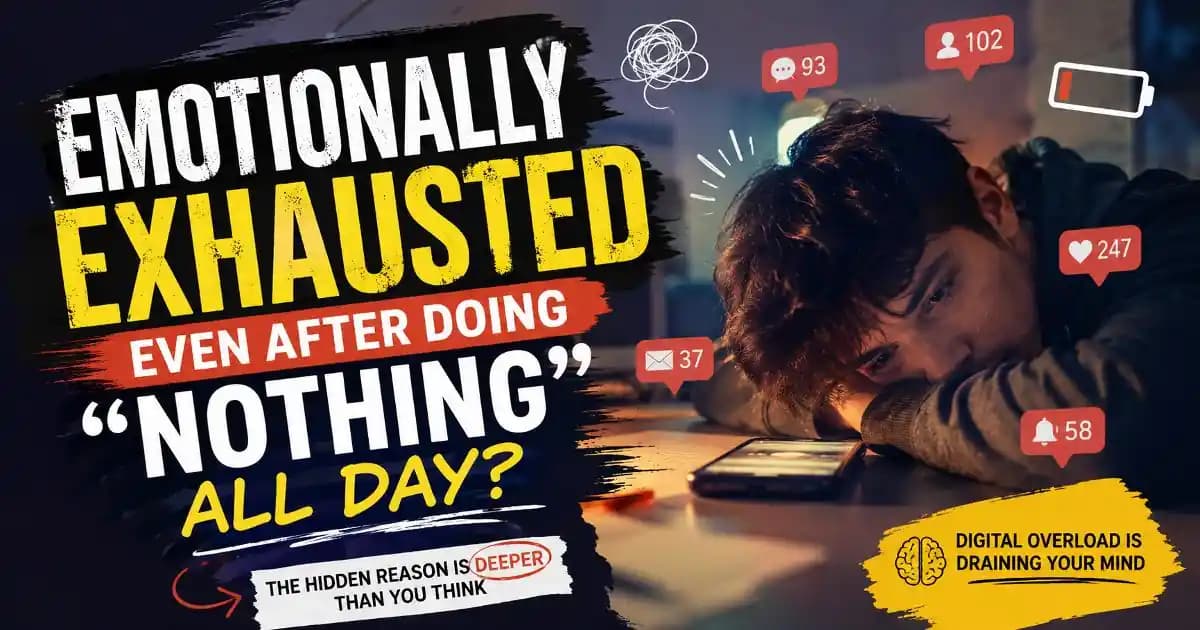
Emotional exhaustion no longer looks the way most people expect it to. Sometimes it does not come from overworking, parenting, crisis, or major emotional conflict. Sometimes it comes from spending an entire day online without ever fully resting inside your own mind.
You wake up, check notifications before your feet touch the floor, answer a few messages, scroll while eating, switch between tabs during work, open short videos during breaks, listen to podcasts while replying to emails, and end the night half-watching something while scrolling another screen. By midnight, it feels like nothing physically demanding happened. Yet emotionally, your brain feels strangely heavy.
A growing number of people quietly live inside this version of fatigue. Not dramatic burnout. Not complete collapse. Just a constant low-level emotional depletion that follows them through ordinary days.
The strange part is how invisible it feels. Modern digital life trains people to associate exhaustion only with productivity. If you did not accomplish something difficult, you assume you should not feel drained. But the human nervous system does not measure exhaustion only through physical effort. It also responds to attention fragmentation, emotional exposure, decision overload, social comparison, and continuous mental stimulation.
Emotional exhaustion is no longer only connected to work
For years, exhaustion was mostly framed around overwork. But in 2025 and 2026, many people experience emotional burnout through constant cognitive consumption instead.
The modern internet rarely allows the brain to settle into stillness. Even moments that appear relaxing are often emotionally stimulating underneath. A person scrolling social media may absorb political outrage, relationship drama, productivity advice, financial anxiety, beauty standards, AI fears, celebrity conflict, global tragedy, and motivational messaging within twenty minutes.
The brain processes far more than people consciously realize.
Part of the problem is that digital platforms are designed around emotional activation. Algorithms reward content that triggers curiosity, anxiety, outrage, validation, urgency, or comparison because emotionally charged attention keeps users engaged longer.
That means many people spend hours each day inside emotionally intensified environments without recognizing how deeply those environments affect their nervous system.
The exhaustion often feels confusing because passive consumption creates the illusion of rest. Sitting still while consuming content looks inactive from the outside. But mentally, the brain is constantly switching context, interpreting emotional signals, filtering information, comparing identities, and responding to stimulation.
This is one reason doomscrolling behavior feels difficult to stop even when it leaves people emotionally worse afterward. The brain keeps searching for emotional resolution that never fully arrives.
Digital overstimulation changes how the brain experiences attention
One of the biggest hidden causes of emotional exhaustion is attention fragmentation.
Modern digital routines train the brain to rapidly switch focus every few seconds. Notifications interrupt thought patterns. Short-form videos accelerate attention pacing. Multitasking becomes normalized. Even relaxation is interrupted by constant checking behaviors.
Over time, the brain adapts to this fragmented rhythm.
Many people now struggle to remain emotionally present with a single experience for long periods. Quiet moments begin to feel uncomfortable. Silence feels empty. Focus feels harder. Emotional processing becomes shallow because attention rarely stays in one place long enough.
This creates a subtle but exhausting psychological state where the brain never fully resets.
Remote work culture has intensified this pattern. Home spaces that once represented emotional recovery now contain work notifications, meetings, productivity apps, AI tools, Slack messages, content feeds, and digital interruptions all inside the same environment.
The emotional boundaries between work, entertainment, rest, and identity have become blurred.
Many people are technically resting while their nervous system remains psychologically alert.
Passive consumption still creates emotional load
One of the most misunderstood parts of digital fatigue is the emotional weight of passive consumption.
People often assume emotional energy is only spent through active participation. But simply witnessing large amounts of emotional information can quietly overwhelm the brain.
A person may spend hours consuming videos about self-improvement, trauma recovery, relationships, productivity, economic fear, loneliness, dating advice, or AI replacing jobs. Even when the content is helpful individually, constant emotional input without recovery time creates cognitive overload.
The modern internet rarely gives people space to emotionally digest what they consume.
Instead, people move immediately from one emotionally stimulating piece of content to another. The nervous system stays continuously activated while emotional processing remains unfinished.
This is why many people describe feeling emotionally numb while simultaneously feeling overstimulated.
The brain reaches a point where it can no longer emotionally absorb everything being presented to it.
The attention economy profits from emotional intensity
The attention economy does not simply compete for time anymore. It competes for emotional reaction.
Every platform wants users to stay engaged longer, respond faster, click more often, and return repeatedly throughout the day. Emotional stimulation became one of the most effective ways to achieve that.
That creates an environment where people rarely experience emotional neutrality online.
Even positive content often carries subtle pressure underneath it. Productivity videos can trigger inadequacy. Wellness content can create self-monitoring anxiety. Relationship advice can increase emotional overanalysis. Personal branding culture can make ordinary life feel insufficient.
The emotional exhaustion many people feel today is partially connected to living inside constant psychological comparison systems.
Social media behavior quietly conditions people to evaluate themselves continuously. Am I productive enough? Attractive enough? Successful enough? Emotionally evolved enough? Social enough? Creative enough?
The brain was never designed to maintain this level of constant identity evaluation for hours every day.
Modern loneliness looks different online
Another hidden layer of emotional exhaustion comes from the emotional contradiction of being digitally connected while psychologically disconnected.
Many people spend most of their day interacting with screens, messages, feeds, meetings, and online communities while still feeling emotionally isolated underneath.
Modern loneliness is not always physical isolation anymore. Sometimes it is emotional disconnection inside constant digital interaction.
People consume thousands of emotional signals daily but experience very little emotionally grounded connection. Conversations become fragmented. Attention becomes divided. Presence becomes partial.
This creates a strange emotional state where the brain remains socially stimulated but emotionally undernourished.
The nervous system often cannot distinguish between meaningful emotional connection and endless digital interaction. Both require energy. Only one truly restores it.
Why doing “nothing” can still feel exhausting
When people say they “did nothing all day,” what they often mean is they did nothing physically measurable.
But emotionally and cognitively, their brain may have processed hundreds of micro-interactions.
Notifications.
Videos.
Text conversations.
Emails.
Comparisons.
News.
Recommendations.
Algorithmic content.
AI-generated media.
Background anxiety.
Identity performance.
Decision fatigue.
Attention switching.
Emotional self-monitoring.
That accumulation matters.
The human brain still needs periods of emotional quiet to recover. But many modern routines remove those recovery spaces almost entirely. Even boredom has disappeared for many people because every empty moment gets filled with stimulation.
And without emotional silence, exhaustion begins to feel permanent.
Digital detox conversations are becoming more emotional than technological
Interestingly, many conversations around digital detox habits are no longer just about screen time. They are about emotional clarity.
People are beginning to notice how different their mind feels after spending even short periods away from constant digital input. Thoughts slow down. Emotional awareness returns. Attention feels less fragmented. Internal emotions become easier to recognize.
This does not mean technology itself is inherently harmful. Modern digital life also provides creativity, connection, opportunity, learning, humor, and emotional support.
But the nervous system still needs recovery from continuous stimulation.
Many people are not emotionally exhausted because they are weak, lazy, or unmotivated. They are emotionally overloaded from living inside environments that constantly compete for psychological attention.
And unlike physical exhaustion, emotional exhaustion often builds quietly enough that people stop noticing it until their patience disappears, motivation drops, sleep worsens, or emotional numbness becomes normal.
The deeper issue is emotional recovery
The real problem is not simply screen time. It is the disappearance of emotional recovery spaces.
Moments where the brain is not consuming.
Not reacting.
Not comparing.
Not performing.
Not optimizing.
Not responding.
Just existing without constant input.
Modern life increasingly treats every moment as monetizable attention space. But emotionally, human beings still require mental stillness to feel psychologically balanced.
That is why many people feel unexpectedly emotional after taking breaks from social media, walking without headphones, spending time offline, or having uninterrupted conversations. The nervous system finally experiences reduced stimulation long enough to emotionally regulate again.
Emotional exhaustion is not always dramatic. Sometimes it simply feels like losing emotional sharpness toward your own life.
And for many people in 2025 and 2026, that feeling is becoming quietly familiar.