


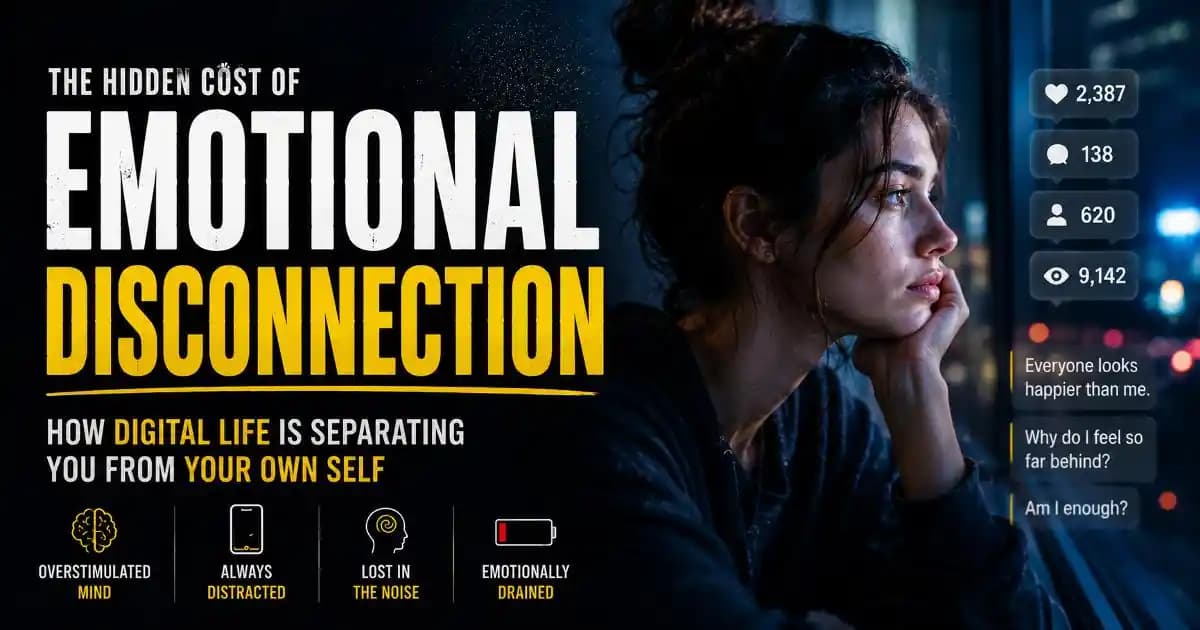
Emotional disconnection often feels strangely difficult to explain because many people are still functioning normally on the surface. They go to work, scroll through apps, reply to messages, watch videos, stay updated online, and continue moving through daily routines. But underneath all of that activity, many quietly notice something unsettling.
They no longer feel deeply connected to their own inner world.
Thoughts feel fragmented. Emotions feel harder to identify clearly. Silence feels uncomfortable. Reflection feels mentally crowded. Even moments alone often become filled instantly with content, scrolling, notifications, or background stimulation.
For many people, the mind rarely feels emotionally quiet anymore.
This experience has become increasingly common inside modern digital culture, especially as internet life grows faster, louder, and more emotionally overwhelming every year.
People are absorbing enormous amounts of information constantly while spending less uninterrupted time with their own internal thoughts.
And gradually, many are beginning to feel emotionally distant from themselves without fully understanding why.
Why modern digital life creates emotional disconnection
The human mind was never designed to process the level of stimulation modern digital environments now produce continuously.
People wake up and immediately absorb messages, headlines, videos, opinions, algorithms, social updates, AI-generated content, productivity advice, emotional reactions, and endless online conversation.
Attention rarely settles for long.
The nervous system keeps shifting between emotional states rapidly throughout the day.
Someone watches upsetting news, then comedy clips, then relationship content, then motivational advice, then online arguments, then lifestyle influencers, then work messages all within minutes.
This constant emotional switching fragments mental focus.
Over time, many people stop fully processing their own emotional experiences because the brain remains occupied reacting to external stimulation almost nonstop.
Instead of sitting with thoughts naturally, people increasingly move past them before emotional understanding fully forms.
People rarely experience uninterrupted thinking anymore
One of the quietest psychological shifts of the digital era is how little uninterrupted mental space many people now experience daily.
Moments that once allowed reflection waiting in silence, walking alone, sitting quietly, commuting, resting, or simply feeling bored are now often immediately filled with stimulation.
Phones eliminate psychological pauses almost instantly.
Whenever discomfort, uncertainty, boredom, loneliness, or emotional tension appears, many people instinctively reach for content before thoughts can fully settle.
This behavior became so normalized that people rarely question it anymore.
But uninterrupted thought matters emotionally.
Human beings historically developed self-awareness partly through internal reflection. Thoughts unfolded slowly. Emotions had time to surface naturally. Identity formed through lived experience rather than continuous algorithmic interruption.
Now attention is constantly redirected outward.
As a result, many individuals quietly lose emotional familiarity with their own inner voice.
The attention economy rewards external focus
The attention economy depends on keeping people emotionally engaged with external stimulation.
Apps, feeds, creator platforms, streaming systems, AI tools, and social media algorithms are all designed to compete continuously for attention.
The longer people remain externally focused, the more emotionally engaged these systems become.
This creates environments where attention rarely rests inward for very long.
Modern digital culture increasingly trains people to seek constant stimulation, constant reaction, constant updates, and constant emotional engagement from outside themselves.
Over time, many people become uncomfortable with slower emotional states because silence now feels unfamiliar.
For some individuals, being alone with their own thoughts starts feeling mentally restless instead of emotionally grounding.
Why emotional overstimulation creates mental numbness
Many people assume emotional disconnection means feeling nothing.
Often the opposite is true.
Modern internet culture exposes people to so much emotional information that the nervous system eventually becomes overwhelmed.
People absorb outrage, fear, humor, anxiety, comparison, loneliness, productivity pressure, emotional storytelling, political conflict, social validation systems, and algorithmic stimulation all day long.
The emotional system rarely fully recovers between experiences.
Eventually, some individuals begin feeling emotionally muted not because they stopped feeling completely, but because the nervous system becomes overloaded.
This emotional flattening can create a strange psychological distance from internal thoughts and emotions.
People continue functioning externally while privately feeling emotionally unclear, mentally fatigued, or disconnected from what they genuinely feel underneath constant stimulation.
Online culture changed how people process identity
Another reason emotional disconnection feels increasingly common is because identity itself became more externally shaped online.
People now spend large amounts of time inside environments built around visibility, performance, comparison, and public interpretation.
Social media encourages individuals to think about how life appears while living it.
Experiences become content. Emotions become posts. Opinions become identity signals. Validation becomes measurable through reactions and engagement.
Over time, this creates subtle psychological self-monitoring.
Many people begin paying more attention to how they appear emotionally than to what they actually feel internally.
This weakens emotional intimacy with the self.
The mind becomes highly aware of external perception while slowly losing clarity around internal emotional experience.
Why people avoid their own thoughts without realizing it
For many individuals, constant stimulation also becomes a form of emotional avoidance.
Modern digital environments provide endless distraction from uncertainty, grief, loneliness, insecurity, anxiety, heartbreak, boredom, and unresolved emotional tension.
Whenever uncomfortable feelings begin surfacing, the internet offers immediate emotional interruption.
Scrolling creates temporary relief because it redirects attention outward quickly.
But distraction and emotional processing are not the same thing.
When people continuously escape inward discomfort through stimulation, emotions often remain unresolved beneath the surface.
Eventually, many individuals stop trusting their own emotional clarity because they spend very little uninterrupted time actually listening to themselves deeply anymore.
AI-generated culture is increasing mental fragmentation
The rise of AI-generated content is intensifying emotional fragmentation even further.
People now consume enormous amounts of hyper-optimized digital material created to maximize attention, emotional engagement, and behavioral retention.
Algorithms personalize emotional stimulation continuously.
The result is a digital environment where attention moves faster than internal emotional processing can naturally keep up with.
Many people quietly notice they feel mentally scattered after long periods online.
Thoughts become harder to hold steadily. Reflection becomes interrupted. Emotional attention fractures more easily.
This does not necessarily mean people are becoming less intelligent or less emotionally capable.
It means human psychology is adapting to environments built around nonstop cognitive stimulation.
Why slower experiences now feel emotionally unfamiliar
One reason some people feel unexpectedly emotional during quieter offline moments is because the nervous system finally experiences reduced stimulation after remaining continuously activated.
Walking without headphones, journaling, reading slowly, sitting in silence, spending time in nature, or having uninterrupted conversations can initially feel uncomfortable for individuals deeply adapted to fast-moving digital rhythms.
But after enough time, many describe these experiences as mentally calming and emotionally clarifying.
That clarity often reflects attention finally settling inward again.
The emotional system begins reconnecting with thoughts that constant stimulation kept buried beneath noise and distraction.
Emotional disconnection is becoming a modern psychological pattern
The growing emotional disconnection many people experience today is not simply personal weakness or lack of discipline.
It reflects how deeply internet culture reshaped attention, identity, emotional processing, and human behavior.
Modern digital life continuously pulls awareness outward through stimulation, performance, comparison, visibility, and emotional overload.
Eventually, many people begin feeling psychologically distant from themselves because attention rarely spends enough uninterrupted time inward anymore.
This emotional distance can quietly affect relationships, confidence, focus, creativity, emotional clarity, and the ability to feel fully present in life.
And increasingly, many individuals are beginning to realize that emotional wellbeing in the digital age may depend partly on protecting moments where the mind no longer has to react constantly.
Moments where thoughts can unfold slowly again.
Moments where attention is not competing against algorithms.
Moments where people can hear themselves think clearly enough to feel emotionally connected to their own inner life once more.