


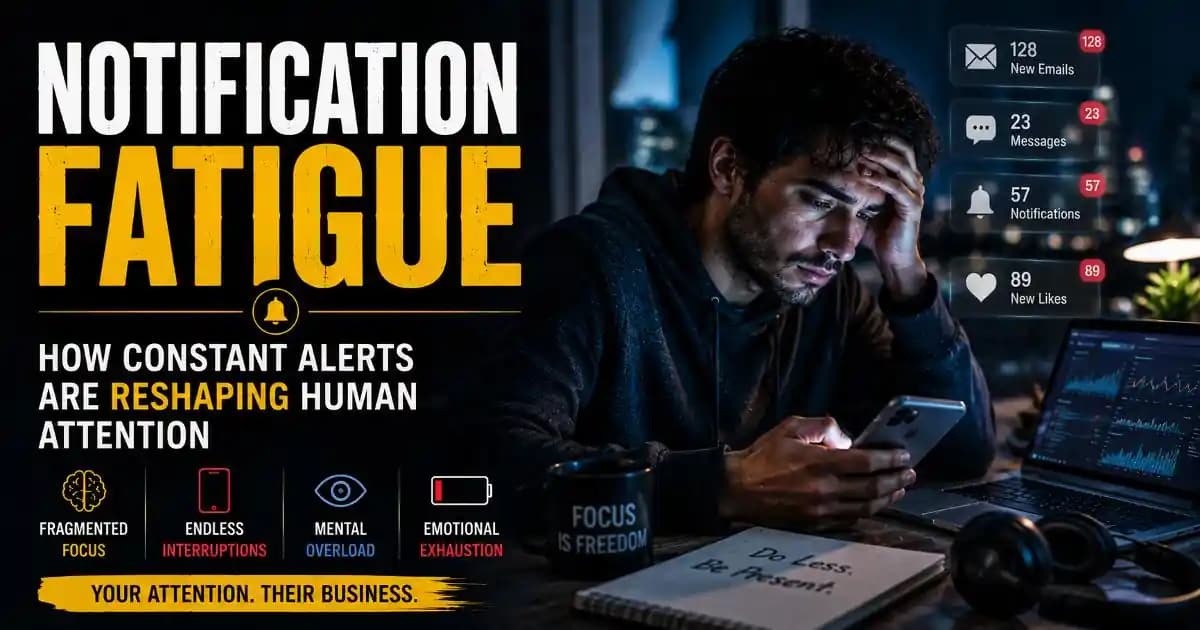
Notification fatigue often feels invisible at first because constant interruptions have become so normal inside modern digital life.
A phone vibrates during dinner. A smartwatch lights up during conversation. An email appears while someone is already replying to messages somewhere else. A social media notification interrupts work. Another app requests attention moments later.
Most people barely pause to think about how frequently their attention gets pulled away anymore.
The interruptions blend into ordinary life.
But emotionally and psychologically, the nervous system still reacts to every alert, vibration, badge icon, popup, and incoming message. Even tiny interruptions require the brain to shift focus repeatedly throughout the day.
Over time, this constant fragmentation quietly changes how people think, feel, communicate, rest, and experience attention itself.
Many individuals now move through life mentally overstimulated while struggling to understand why they feel emotionally tired even during relatively ordinary days.
Why notification fatigue affects the nervous system so deeply
Human attention was never designed for nonstop digital interruption.
Historically, moments of focus, silence, boredom, reflection, and emotional stillness happened more naturally throughout daily life. Conversations unfolded without constant alerts competing for attention. Work contained clearer boundaries. Mental transitions happened more gradually.
Modern digital systems removed many of those pauses.
Now attention exists inside environments specifically engineered to capture and redirect focus continuously.
Every notification signals possible importance: social connection, work responsibility, emotional validation, urgency, opportunity, entertainment, or potential threat.
The brain reacts automatically because human psychology evolved to monitor social and environmental signals carefully.
Even when people consciously ignore notifications, the nervous system still partially registers interruption and anticipation.
That low-level vigilance accumulates emotionally across entire days.
The attention economy depends on interruption
The modern attention economy is built around maintaining engagement for as long as possible.
Apps, platforms, social systems, creator ecosystems, productivity tools, AI assistants, and online services all compete continuously for limited human attention.
Notifications became one of the most effective tools for pulling people back into digital environments repeatedly.
Every alert creates a tiny psychological opening that encourages re-engagement.
Sometimes the interruption feels useful. Sometimes emotionally rewarding. Sometimes stressful. Sometimes meaningless.
But the nervous system rarely receives enough uninterrupted time to fully settle anymore.
As a result, many people now live in states of ongoing partial attention where the mind constantly anticipates the next interruption even during quiet moments.
This fragmented mental state is becoming one of the defining psychological patterns of modern internet culture.
Why people feel mentally exhausted after “doing nothing”
One reason notification fatigue feels emotionally confusing is because many people become mentally drained even when they were not doing physically demanding work.
Someone spends hours switching between messages, apps, alerts, emails, social feeds, videos, reminders, group chats, AI tools, and digital tasks without ever entering sustained mental stillness.
The brain remains continuously active.
Each interruption forces small cognitive adjustments: shifting focus, evaluating importance, regulating emotion, deciding whether to respond, and reorienting attention again afterward.
Individually, these interruptions appear minor.
Collectively, they create substantial mental overload.
Many people now finish ordinary days feeling strangely depleted because the nervous system spent hours managing fragmented attention without enough recovery.
Constant alerts changed how people experience presence
Notification fatigue also quietly reshaped emotional presence itself.
Many conversations now happen while attention remains partially divided between physical reality and possible digital interruption.
Someone checks a phone during dinner without fully intending to disconnect emotionally. A message appears during conversation. A vibration interrupts eye contact. A notification silently shifts mental focus elsewhere for a few seconds.
These moments seem small individually.
But repeated interruption weakens emotional continuity over time.
People remain socially connected while psychologically fragmented.
This is partly why many individuals now describe feeling emotionally distracted even during meaningful experiences. Attention rarely belongs fully to one moment anymore because digital systems continuously compete for awareness.
Why silence now feels emotionally unfamiliar
One of the quietest effects of notification fatigue is that many people no longer experience enough uninterrupted silence for the nervous system to fully relax.
Moments that once naturally contained boredom, reflection, waiting, or mental stillness now often become filled instantly with alerts, updates, scrolling, or digital stimulation.
The brain becomes conditioned to expect interruption.
Eventually, silence itself can start feeling psychologically unusual.
Some individuals instinctively check devices during even brief pauses because the nervous system became deeply accustomed to continuous input.
This creates emotional restlessness that many people mistake for personal lack of focus rather than environmental overstimulation.
In reality, modern digital environments continuously train attention toward reactivity.
Social media intensified notification anxiety
Social media platforms intensified notification fatigue by connecting attention directly to emotional validation and social visibility.
Likes, replies, mentions, comments, reactions, shares, follows, and direct messages all carry emotional meaning for the brain because they signal recognition and social relevance.
This makes notifications psychologically difficult to ignore completely.
Someone hears a phone buzz and immediately wonders: Who messaged? Did something happen? Did someone respond? Am I missing something important?
The emotional anticipation becomes automatic.
For many people, constant connectivity created low-level anxiety around being unavailable, uninformed, emotionally disconnected, or socially absent.
This pressure keeps the nervous system partially alert throughout the day even during periods that should feel restful.
Remote work blurred attention boundaries even further
Remote work culture accelerated notification fatigue dramatically.
Work communication now follows many people everywhere through Slack, Teams, email systems, project management platforms, collaborative apps, AI-assisted workflows, and mobile notifications.
Professional attention rarely fully turns off.
Someone checks messages before sleeping. Responds during meals. Mentally monitors work channels while spending time with family. Takes breaks while remaining emotionally available for incoming tasks.
The nervous system struggles to distinguish between work time and recovery time because digital communication blurred those emotional boundaries.
Many remote workers quietly feel exhausted not only from workload, but from permanent attentional openness.
AI systems are accelerating attention fragmentation
The rise of AI-powered ecosystems is intensifying notification fatigue even further.
AI systems accelerate communication speed, content generation, productivity workflows, customer expectations, and digital engagement cycles.
As technology becomes more responsive, human attention increasingly feels pressured to respond just as quickly.
People now receive more information, more reminders, more recommendations, more automated updates, and more personalized digital prompts than ever before.
The emotional brain still processes all of it as incoming stimulation.
Eventually, many individuals begin feeling mentally scattered because attention rarely remains in one place long enough to feel emotionally grounded.
Why notification fatigue affects emotional wellbeing
Attention is deeply connected to emotional wellbeing.
When attention becomes continuously fragmented, emotional regulation becomes harder too.
People often notice symptoms like irritability, mental fog, reduced patience, emotional numbness, overstimulation, sleep disruption, difficulty concentrating, and feeling psychologically “full” even without obvious crisis.
This happens partly because the nervous system rarely experiences complete cognitive rest anymore.
Instead, the brain remains partially prepared for the next interruption constantly.
Over time, many people quietly lose familiarity with what sustained calm attention even feels like.
People increasingly crave uninterrupted attention again
One reason slower offline experiences feel emotionally powerful now is because they temporarily restore attentional continuity.
Long conversations without phones, reading physical books, quiet walks, time in nature, device-free meals, journaling, or simply sitting without notifications often create noticeable emotional relief.
The nervous system finally stops anticipating interruption for a while.
Attention settles naturally instead of remaining continuously reactive.
For many people, this emotional calmness feels surprisingly unfamiliar because modern digital life rarely allows attention to remain undivided for very long.
Notification fatigue reflects a larger cultural shift
The deeper issue beneath notification fatigue is not simply that people receive too many alerts.
It is that modern digital culture transformed human attention into a constantly contested resource.
Apps, platforms, algorithms, creators, advertisers, AI systems, workplaces, and online communities all compete continuously for emotional engagement.
The nervous system absorbs the cumulative pressure of that competition every day.
Eventually, many people begin feeling emotionally exhausted not because they are incapable of focusing, but because their attention rarely experiences uninterrupted stability anymore.
And increasingly, many individuals are beginning to realize that protecting emotional wellbeing in modern life may depend partly on protecting attention itself.
Not perfectly. Not through total disconnection.
But through creating moments where the mind no longer has to remain permanently available for interruption.