


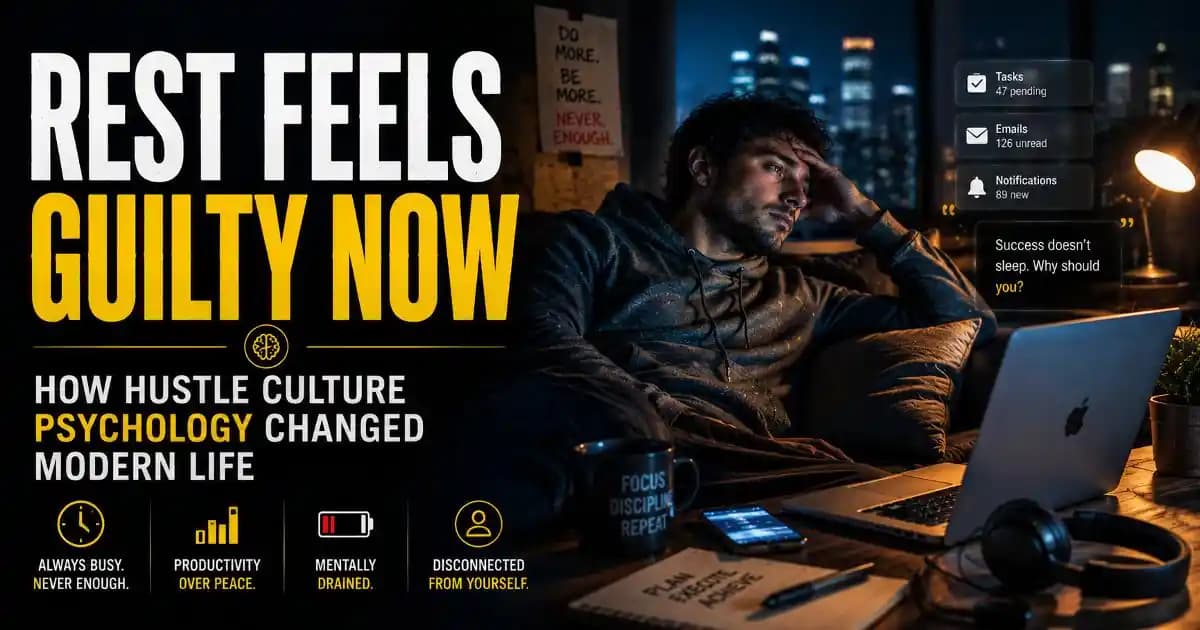
Hustle culture psychology increasingly shapes how people emotionally experience rest, even during moments that are supposed to feel peaceful.
Someone sits down on a quiet evening to relax but instinctively reaches for productivity videos, career advice, emails, online courses, or self-improvement content instead. Another person takes a day off but spends most of it feeling vaguely guilty for not being useful enough. Someone else watches a movie while mentally calculating unfinished tasks in the background.
For many people, true rest no longer feels emotionally simple.
Modern internet culture quietly changed the emotional meaning of downtime itself. Rest increasingly feels like something that must be earned, optimized, justified, or transformed into future productivity.
This shift happened gradually through social media, creator culture, online work systems, self-improvement content, startup culture, productivity influencers, AI-powered workflows, and algorithmic environments that reward constant activity.
As a result, many people now feel psychologically uncomfortable whenever they stop performing for too long.
The exhaustion this creates is often subtle rather than dramatic. People continue functioning normally while privately feeling unable to fully disconnect from pressure, stimulation, or internal productivity expectations.
Why hustle culture psychology became emotionally powerful
Human beings naturally want purpose, progress, achievement, and meaning. Productivity itself is not inherently harmful.
The deeper issue is that modern digital culture gradually blurred the emotional boundary between healthy ambition and constant self-optimization.
Online platforms reward visible discipline constantly. Morning routines become content. Work habits become identity signals. Personal growth becomes performance. Free time becomes monetization opportunity.
Eventually, many people stop seeing rest as emotionally valuable on its own.
Instead, rest becomes acceptable only when it serves future output.
Someone sleeps to become more productive. Exercises to maximize efficiency. Meditates to optimize focus. Takes breaks strategically rather than emotionally.
Even recovery becomes performance-oriented.
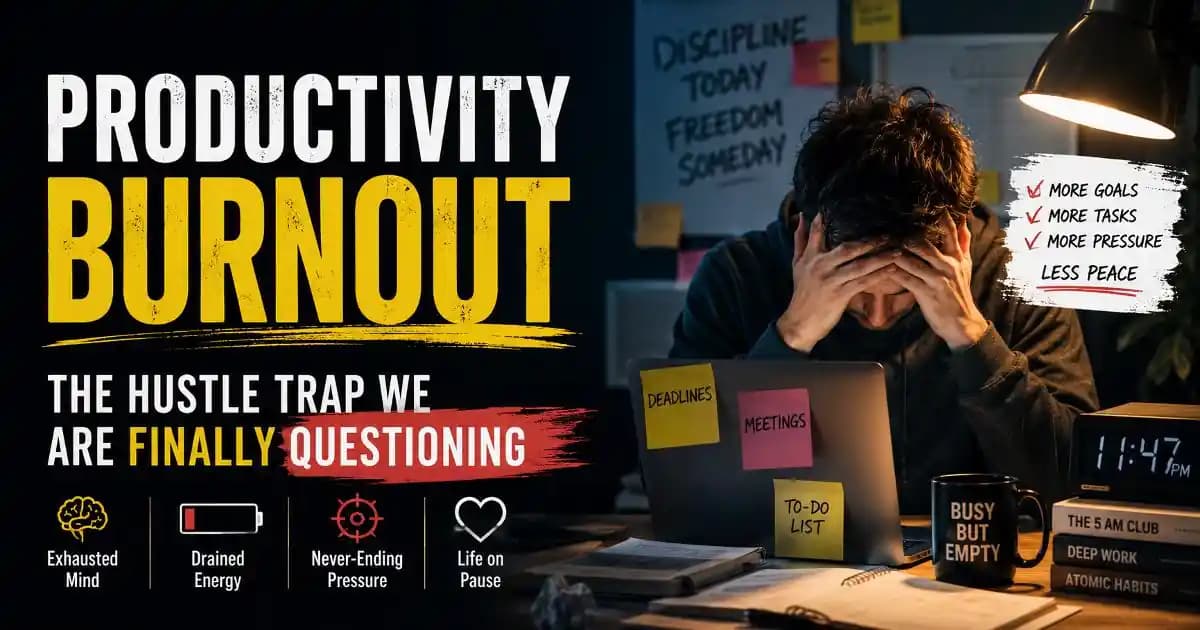
This psychological shift is one reason modern burnout often feels emotionally confusing. People may technically rest while internally remaining attached to achievement pressure the entire time.
The internet normalized constant self-improvement
One reason rest feels emotionally difficult now is because online culture normalized endless self-improvement as a permanent lifestyle.
People spend hours consuming content about discipline, optimization, routines, wealth building, productivity systems, AI tools, creator success stories, personal branding, and career acceleration.
Much of this content sounds motivating individually.
But emotionally, the combined effect can create quiet psychological pressure that never fully stops.
Someone else always appears more focused, more productive, more financially successful, more emotionally disciplined, or more optimized online.
The emotional brain absorbs these comparison signals continuously even when people consciously understand that social media shows highly curated lives.
Over time, ordinary rest can begin feeling emotionally suspicious because internet culture subtly frames constant momentum as proof of personal value.
Why doing nothing now feels psychologically uncomfortable
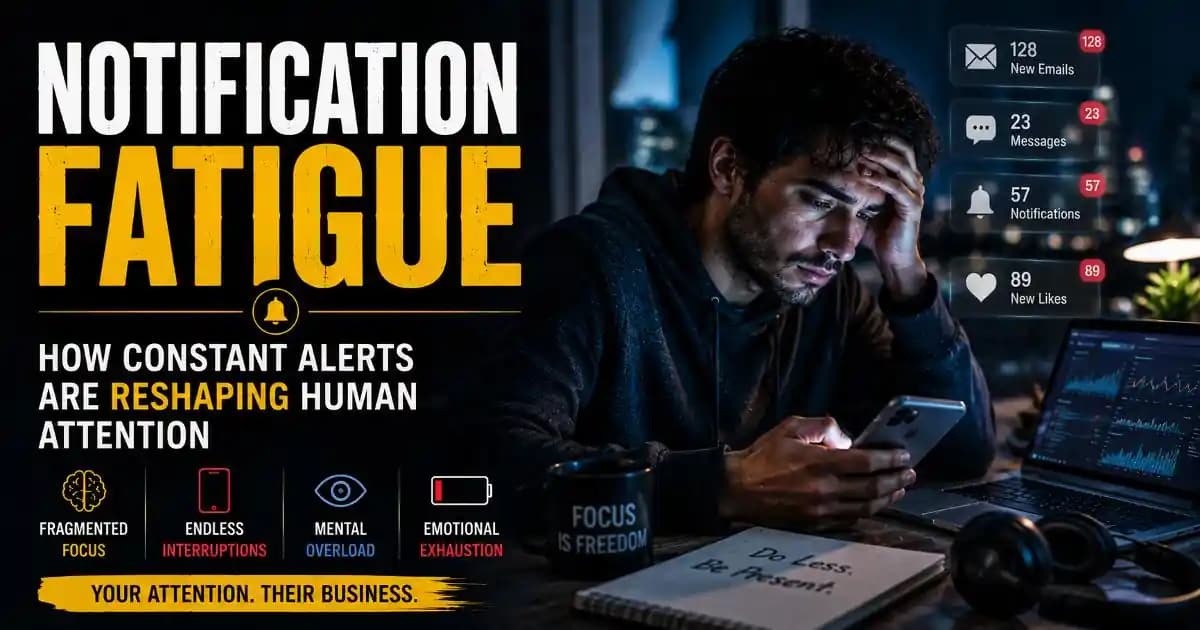
Many people notice they struggle to sit quietly without reaching for stimulation.
Moments that once naturally allowed boredom, reflection, emotional processing, or mental stillness are now quickly filled with scrolling, videos, podcasts, notifications, work updates, or productivity content.
The nervous system becomes accustomed to constant engagement.
As a result, silence itself can start feeling emotionally uncomfortable.
This matters because emotional recovery depends partly on moments where the mind no longer has to perform, react, compare, or optimize continuously.
Historically, people experienced more natural psychological pauses throughout daily life. Walking, waiting, commuting, resting, or spending quiet time often happened without endless digital interruption.
Modern attention systems eliminate many of those pauses instantly.
Whenever discomfort appears, stimulation becomes immediately available.
That constant stimulation makes genuine rest harder for the nervous system to recognize emotionally.
The attention economy rewards exhaustion
The attention economy benefits from keeping people mentally engaged for as long as possible.
Algorithms continuously surface content designed to trigger ambition, comparison, urgency, emotional reaction, and behavioral engagement.
Productivity content performs especially well online because it taps directly into identity, insecurity, aspiration, and fear of falling behind.
Many people now move through digital environments where self-worth feels quietly connected to visible output.
This creates emotional conditions where slowing down can feel psychologically threatening rather than restorative.
Some individuals begin interpreting rest as laziness instead of recovery.
Others feel guilty whenever they are not improving something about themselves.
Even hobbies gradually become side hustles, content opportunities, or personal branding projects.
Eventually, many people stop experiencing enough emotionally unstructured time to feel mentally settled.
Remote work blurred emotional boundaries even further
Remote work culture intensified hustle culture psychology in subtle ways.
Work no longer stays in specific physical environments for many people. Notifications follow workers everywhere through phones, laptops, collaborative apps, AI-assisted systems, and digital communication platforms.
The nervous system rarely feels completely separated from professional identity.
Someone answers messages during dinner. Checks Slack before bed. Monitors emails while watching television. Takes vacations while remaining partially psychologically available for work.
This ongoing accessibility weakens emotional recovery cycles.
Many remote workers now experience low-level mental alertness almost continuously because digital work culture normalized permanent reachability.
As a result, rest often feels incomplete.
Why social media turned productivity into identity
Internet culture also changed how people emotionally perform ambition publicly.
Productivity is no longer only personal behavior. It increasingly functions as social identity.
Online culture rewards visible busyness: aesthetic workspaces, intense routines, side projects, creator schedules, startup culture, gym discipline, optimized calendars, and high-performance lifestyles.
This creates emotional comparison environments where many individuals begin measuring themselves against idealized versions of productivity.
Someone scrolling online late at night may suddenly feel inadequate simply because other people appear endlessly driven.
The emotional goalpost keeps moving.
No matter how much someone accomplishes, internet culture always presents another version of success requiring even more optimization.
This psychological environment quietly disconnects people from emotional satisfaction because enough never fully feels like enough.
AI productivity culture is increasing pressure even more
The rise of AI tools intensified modern productivity expectations dramatically.
AI systems increase efficiency, accelerate workflows, automate repetitive tasks, and allow individuals to produce more content faster than ever before.
But emotionally, these systems also increase psychological pressure.
Many people now feel they should constantly learn new tools, adapt faster, work smarter, stay competitive, and maximize every hour because technology keeps accelerating output expectations.
The emotional fear is no longer only about failure.
For some individuals, it becomes fear of irrelevance.
This creates a strange emotional contradiction where people feel exhausted while simultaneously feeling behind.
The nervous system struggles to emotionally adapt to environments that rarely stop demanding optimization.
Why rest now feels emotionally undeserved
One of the deepest effects of hustle culture psychology is that many people no longer feel inherently worthy of rest.
Rest becomes conditional.
People feel they must first complete enough work, earn enough money, achieve enough goals, respond to enough messages, or optimize enough parts of life before fully relaxing emotionally.
But digital life continuously generates new tasks, new updates, new comparisons, and new expectations.
The finish line keeps moving.
As a result, many individuals remain psychologically tense even during downtime because part of the mind still feels responsible for being productive.
This emotional tension contributes heavily to modern emotional burnout, attention fatigue, and digital overstimulation.
Many people secretly miss slower emotional rhythms
One reason conversations about burnout and digital exhaustion resonate so strongly now is because many people quietly miss older emotional rhythms more than they expected.
They miss hobbies without monetization pressure. Conversations without multitasking. Walks without content. Rest without guilt. Weekends without constant productivity anxiety.
People increasingly crave emotional spaciousness even if they do not always describe it that way directly.
This partly explains why slower experiences often feel surprisingly emotional now: reading physical books, journaling, cooking slowly, spending time offline, taking quiet walks, or simply sitting without digital stimulation.
These moments allow attention to settle naturally instead of remaining continuously activated.
The nervous system begins remembering what rest actually feels like emotionally.
Human beings were never designed for endless optimization
The deeper issue beneath hustle culture psychology is that modern internet culture increasingly treats human beings like permanent self-improvement projects.
But emotional wellbeing does not operate at algorithmic speed.
Human beings still require stillness, recovery, reflection, emotional presence, relationships, boredom, and psychological space that serves no productive function at all.
Without those experiences, life gradually becomes emotionally mechanical.
People continue performing externally while internally feeling emotionally exhausted, disconnected, or unable to feel fully present in their own lives.
That emotional exhaustion is becoming increasingly common across modern digital culture.
And slowly, more people are beginning to realize that rest is not something human beings must earn after proving enough value.
It is part of what allows the nervous system to remain emotionally human in environments that constantly encourage performance instead of peace.