


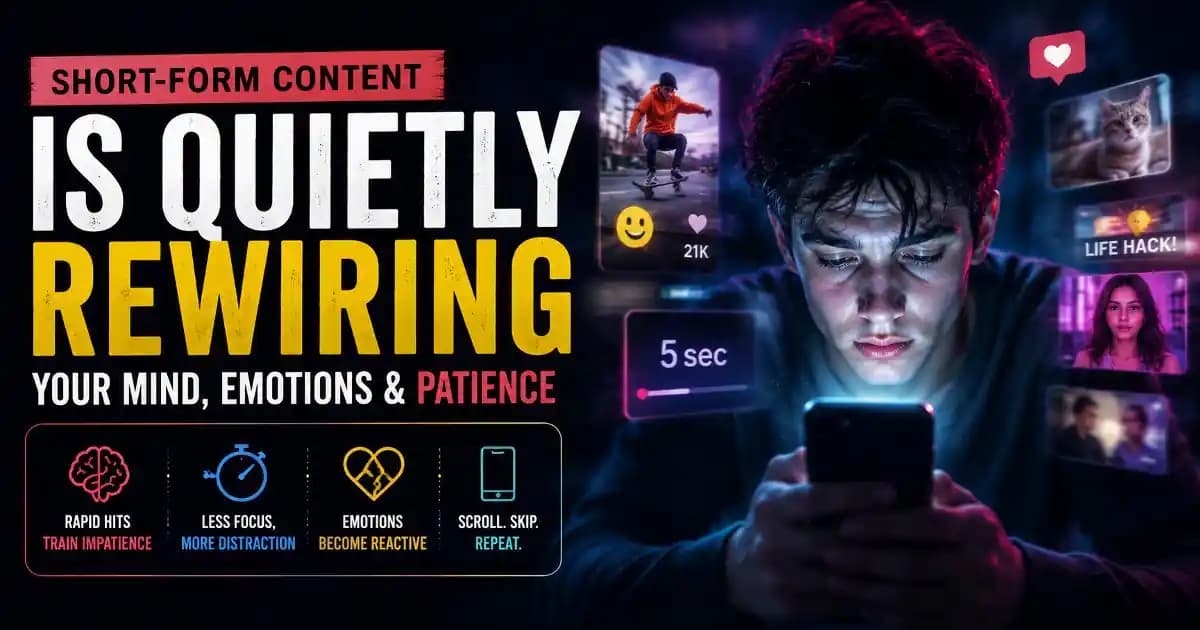
Short-form content psychology has become deeply embedded into everyday life so quickly that many people barely notice how differently their minds now respond to slowness, silence, or emotional waiting.
Someone watches dozens of videos in fifteen minutes, jumps between emotional tones constantly, absorbs fragments of conversations, trends, jokes, outrage, advice, relationship content, AI-generated clips, and motivational speeches then suddenly feels strangely restless when real life moves more slowly.
That emotional shift is becoming increasingly common.
Many people now notice subtle changes in themselves. Conversations feel harder to stay fully present in. Long videos require more effort. Reading feels mentally slower. Emotional discomfort becomes harder to tolerate without distraction. Even moments of boredom can trigger an automatic urge to reach for stimulation.
The issue is not simply shorter attention spans.
Modern short-form content ecosystems may be reshaping emotional patience itself.
Why short-form content feels emotionally addictive
Short-form platforms are designed around rapid emotional engagement.
Every few seconds, the brain receives a new stimulus: humor, surprise, beauty, conflict, validation, curiosity, aspiration, outrage, nostalgia, or emotional relatability.
The emotional rhythm moves extremely fast.
Unlike older forms of media that required sustained attention, modern algorithmic feeds constantly reset emotional stimulation before the brain fully settles into one state.
This creates an experience that feels mentally effortless while quietly keeping the nervous system highly activated.
The brain begins adapting to rapid novelty cycles.
Over time, slower emotional experiences can start feeling psychologically harder to tolerate because they no longer match the stimulation speed the nervous system has become accustomed to.
Emotional patience depends on tolerating slower experiences
Emotional patience is not only about waiting calmly in obvious situations.
It also affects how people handle uncertainty, silence, boredom, frustration, emotional complexity, awkward conversations, slow progress, and unresolved feelings.
Human emotional development historically depended on spending time inside slower experiences.
People sat with thoughts longer. Conversations unfolded gradually. Entertainment required sustained attention. Boredom existed more naturally. Emotional processing happened with fewer interruptions.
Short-form digital environments disrupt many of those slower emotional rhythms.
When the brain becomes used to instant emotional shifts and continuous stimulation, everyday life can begin feeling emotionally under-stimulating by comparison.
This is partly why some people now feel restless during ordinary moments that once felt emotionally neutral.
The attention economy rewards emotional speed
The attention economy prioritizes content that captures attention immediately.
As a result, platforms reward emotional intensity, rapid pacing, instant payoff, visual stimulation, and quick psychological hooks.
Content creators adapt naturally to these systems because slower material often performs worse algorithmically.
Over time, this creates digital environments where patience itself becomes less reinforced.
Many users become emotionally conditioned to expect immediate engagement from almost everything they consume.
And when real life does not deliver stimulation that quickly, emotional frustration increases.
Long-term goals feel harder. Conversations feel slower. Relationships require more emotional effort. Quiet reflection feels uncomfortable. Focus becomes more fragile.
This does not mean short-form content directly “destroys” patience. Human behavior is more complex than that.
But repeated exposure to high-speed emotional stimulation does shape psychological expectations over time.
Why boredom now feels emotionally uncomfortable
Boredom used to function as a normal part of mental life.
Now many people experience boredom almost like a low-level emotional threat.
Moments without stimulation increasingly trigger automatic digital reflexes: opening apps, checking feeds, refreshing notifications, watching clips, or scrolling without conscious intention.
The nervous system becomes less familiar with mental stillness because short-form content continuously fills emotional gaps.
This matters because boredom historically created space for reflection, imagination, emotional processing, creativity, and psychological recovery.
When every pause becomes instantly filled with stimulation, the brain has fewer opportunities to emotionally settle.
Many people now feel mentally exhausted not because they are always working, but because their attention rarely fully rests anymore.
Short-form content changes how people experience relationships
Digital attention patterns inevitably influence relationships too.
Many people now unconsciously expect conversations to maintain constant stimulation similar to algorithmic feeds.
But real emotional connection moves differently.
Relationships involve pauses, repetition, slower emotional understanding, unresolved tension, vulnerability, and moments that are meaningful precisely because they are not instantly rewarding.
Short-form culture can make slower relational experiences feel less emotionally stimulating compared to endless digital novelty.
This sometimes creates subtle impatience inside everyday interactions.
People check phones during conversations more often. Emotional attention fragments more easily. Listening becomes harder to sustain without mental drift toward stimulation.
The issue is not lack of caring. It is that modern digital environments continuously retrain attention habits.
Why emotional discomfort now gets interrupted so quickly
One of the quietest psychological changes happening online is how quickly people now escape emotional discomfort.
Moments of sadness, anxiety, awkwardness, loneliness, uncertainty, or frustration can now be interrupted almost instantly through endless content consumption.
This creates temporary relief.
But emotional avoidance and emotional recovery are not the same thing.
Historically, people often had to remain with emotions longer because fewer instant distractions existed. That did not make earlier generations emotionally perfect, but it did create more situations where emotional processing unfolded naturally over time.
Modern short-form ecosystems reduce emotional friction so efficiently that many people spend less time sitting with internal emotional experiences before distracting themselves away from them.
Over time, emotional tolerance can weaken.
AI-generated content is accelerating stimulation intensity
The rise of AI-generated content is making short-form ecosystems even more emotionally optimized.
AI tools now help create faster editing, stronger hooks, hyper-personalized recommendations, synthetic storytelling, emotionally targeted clips, and highly optimized engagement loops.
The emotional brain still reacts to these systems even when people understand intellectually how algorithmic they are.
This increases stimulation density across digital environments.
People consume more emotional signals in shorter periods than ever before.
The nervous system adapts accordingly.
Many users quietly notice they feel more restless, mentally fragmented, emotionally impatient, or overstimulated after long periods of rapid scrolling.
That reaction is becoming increasingly normalized inside modern digital culture.
Slower experiences now feel surprisingly emotional
One reason some people feel unexpectedly emotional during slower offline moments is because the nervous system finally experiences reduced stimulation after being continuously activated.
Activities like reading quietly, taking walks without headphones, journaling, cooking slowly, spending uninterrupted time with friends, or sitting without screens can initially feel uncomfortable for people deeply adapted to rapid digital pacing.
But after enough time, many describe these slower experiences as emotionally calming.
That calmness often reflects attention settling naturally instead of being continuously redirected.
The emotional system begins recovering some of the patience modern digital life constantly pulls apart.
Human emotions were not designed for endless speed
The deeper issue beneath short-form content psychology is not that people suddenly became weak, distracted, or incapable of focus.
It is that human emotional systems are adapting to environments built around continuous stimulation and accelerated attention cycles.
The modern internet increasingly rewards speed over depth, reaction over reflection, and constant novelty over emotional stillness.
Eventually, many people begin noticing that slower parts of human life relationships, healing, trust, growth, creativity, patience, emotional understanding cannot fully operate at algorithmic speed.
Human emotions still unfold gradually.
And increasingly, many people are realizing that emotional wellbeing may depend partly on protecting spaces in life where attention can slow down enough for the nervous system to feel human again.