


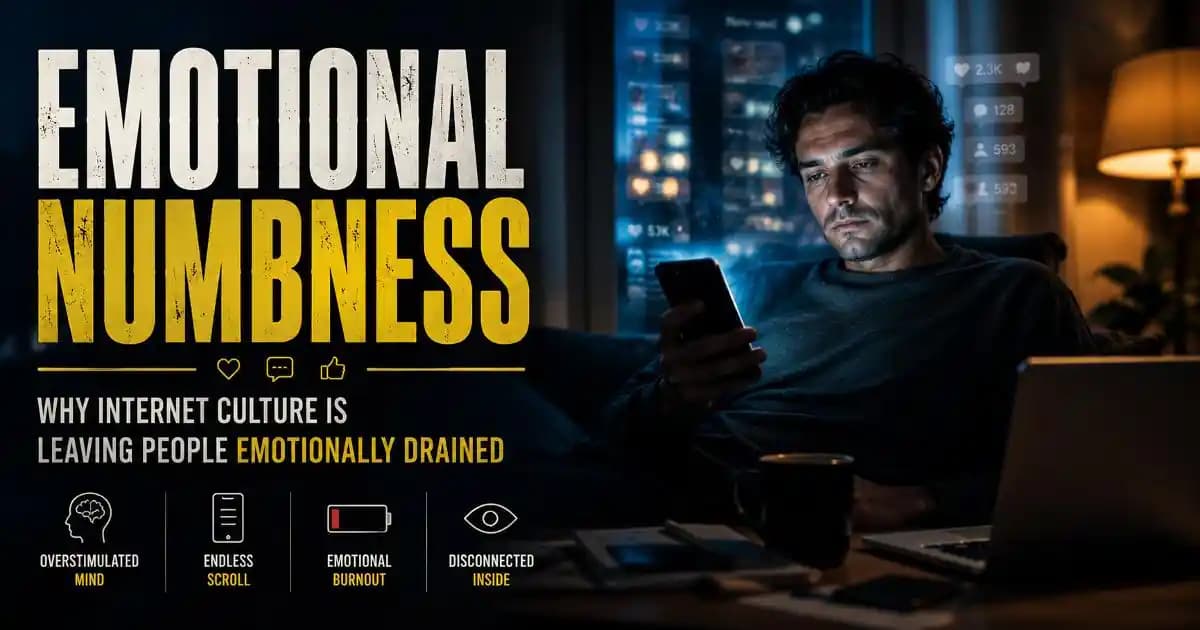
Emotional numbness often arrives quietly now. Someone spends hours online every day, constantly consuming content, reacting to updates, scrolling through emotional stories, watching short videos, replying to messages, following news cycles, and staying digitally connected yet somehow starts feeling less emotionally connected to life itself.
Many people struggle to explain this feeling because nothing appears obviously wrong on the surface.
They still laugh sometimes. They still work, socialize, scroll, consume entertainment, and function normally. But underneath daily routines, many quietly notice a strange emotional flattening.
Excitement feels weaker. Motivation feels inconsistent. Conversations feel harder to stay emotionally present in. Relationships feel emotionally distant even when communication remains constant.
And perhaps most confusing of all, many people feel emotionally exhausted while simultaneously feeling emotionally disconnected.
This contradiction has become increasingly common inside modern internet culture.
Why internet culture creates emotional overload
The human emotional system was never designed to process the volume of emotional information modern digital life now delivers every day.
People wake up and immediately absorb notifications, news alerts, social updates, creator content, emotional opinions, relationship stories, outrage cycles, AI-generated media, viral conflicts, motivational clips, advertisements, productivity pressure, and endless algorithmic stimulation.
The nervous system rarely fully settles.
Every scroll introduces another emotional adjustment.
One video creates empathy. The next creates anxiety. Then humor. Then comparison. Then outrage. Then loneliness. Then inspiration. Then fear about the future.
The emotional brain continuously reacts, adapts, filters, compares, and recalibrates at a speed human psychology did not evolve for.
Over time, emotional overload can gradually shift into emotional shutdown.
Not because people stop caring completely, but because the nervous system becomes overwhelmed by constant emotional activation.
Emotional numbness is often a form of psychological protection
Many people assume emotional numbness means someone is cold, detached, or emotionally broken.
In reality, emotional numbness often develops as a protective response to prolonged overstimulation, stress, uncertainty, or emotional exhaustion.
When the emotional system remains continuously activated for too long, the brain sometimes reduces emotional intensity as a survival mechanism.
This can create a strange psychological state where people continue functioning externally while internally feeling emotionally muted.
Modern internet culture intensifies this process because digital life rarely provides genuine emotional recovery.
Even relaxation increasingly happens through screens that continue stimulating attention and emotion.
People try to rest by scrolling, but endless stimulation often prevents the nervous system from fully calming down.
The attention economy rewards emotional extremes
The modern attention economy depends heavily on emotional activation.
Algorithms prioritize content that creates strong reactions because emotionally charged content keeps people engaged longer.
This means users spend large amounts of time inside environments optimized around emotional intensity rather than emotional stability.
Outrage spreads quickly. Fear spreads quickly. Conflict spreads quickly. Emotional vulnerability becomes content. Personal breakdowns become viral narratives.
Even positive content often arrives in emotionally exaggerated forms designed to compete for attention.
The nervous system adapts to this environment gradually.
Eventually, emotional overstimulation can create emotional fatigue. And emotional fatigue often leads toward numbness.
Many people now describe feeling emotionally tired not because they feel too little, but because they have been feeling too much for too long without enough emotional stillness.
Why constant scrolling creates emotional disconnection
Scrolling culture creates a strange emotional experience where people consume huge amounts of emotional information without fully processing any of it.
Human emotions normally require time, reflection, conversation, and psychological integration.
But modern feeds constantly interrupt emotional processing before it finishes.
Someone watches a heartbreaking video for ten seconds, then instantly moves to comedy, relationship advice, celebrity drama, political conflict, AI-generated entertainment, or aesthetic lifestyle content.
The emotional system never fully settles into one experience long enough to process it naturally.
Over time, emotions can begin feeling fragmented and emotionally shallow.
People react constantly but process very little deeply.
This fragmented emotional rhythm contributes heavily to modern emotional numbness.
Online life changed how people experience relationships
Internet culture also reshaped emotional connection itself.
People communicate constantly now, but much of that communication happens through fragmented digital interactions: reactions, short replies, disappearing stories, memes, notifications, and rapid exchanges competing against endless distractions.
Many relationships remain socially active while becoming emotionally thinner.
People often feel digitally connected yet emotionally unseen.
This creates a subtle loneliness that contributes to emotional detachment over time.
The emotional brain still needs sustained attention, vulnerability, psychological presence, and genuine human closeness.
But constant digital interruption weakens many of those slower emotional experiences.
Eventually, some people stop expecting emotional depth consistently because fast-moving digital environments normalize emotional fragmentation.
AI-generated culture is intensifying emotional fatigue
The rise of AI-generated content is adding another layer to emotional numbness.
People now scroll through increasingly synthetic digital environments filled with AI-generated influencers, emotionally optimized content, artificial intimacy, hyper-polished storytelling, and algorithmically perfected engagement loops.
The emotional brain still reacts to these experiences even when people intellectually know they are partially artificial.
This creates emotional confusion.
Many users feel emotionally overstimulated while simultaneously trusting online experiences less deeply.
The internet increasingly demands emotional attention while offering less emotional certainty.
That emotional distrust contributes to psychological fatigue.
Some people respond by emotionally disengaging without fully realizing it.
Why people keep consuming content even when they feel emotionally drained
One of the most misunderstood parts of emotional numbness is that numbness itself can increase compulsive scrolling.
When people feel emotionally disconnected, they often seek stronger stimulation in hopes of feeling emotionally engaged again.
Endless content feeds provide constant novelty, distraction, and emotional variation without requiring vulnerability or deep reflection.
For a brief moment, stimulation feels easier than emotional stillness.
But continuous stimulation rarely restores emotional clarity.
Instead, it often extends emotional exhaustion because the nervous system never fully rests.
This creates a cycle where people scroll to escape emotional emptiness while the scrolling itself quietly deepens emotional disconnection over time.
Many people no longer experience enough emotional silence
One reason emotional numbness feels increasingly widespread is because modern life leaves very little space for uninterrupted emotional stillness.
People move from work notifications to social feeds to streaming platforms to AI tools to online conversations without many genuine psychological pauses in between.
The brain rarely gets enough time without stimulation to emotionally reset.
Even moments of rest often include background content, multitasking, scrolling, or passive digital consumption.
As a result, many people spend years emotionally activated without fully recognizing how exhausted the nervous system has become.
This is partly why slower offline experiences can feel surprisingly emotional now.
Long conversations, walking without headphones, reading quietly, spending time in nature, journaling, or simply sitting without digital interruption can initially feel uncomfortable then eventually emotionally calming.
The nervous system slowly remembers what uninterrupted emotional presence feels like.
Modern emotional numbness is deeply connected to digital life
The growing emotional numbness many people experience today is not simply personal weakness or lack of gratitude.
It reflects how deeply internet culture reshaped human attention, emotion, relationships, and psychological rhythms.
Modern digital environments continuously pull emotional energy outward. They encourage constant reaction, constant comparison, constant stimulation, and constant emotional exposure.
Eventually, many nervous systems begin protecting themselves through emotional flattening.
That response is becoming increasingly common.
The important thing is recognizing that emotional numbness does not always mean someone has stopped feeling completely. Sometimes it means they have been emotionally overloaded for too long without enough recovery, stillness, connection, or psychological safety.
And increasingly, many people are beginning to realize that emotional wellbeing in the digital age may depend partly on protecting spaces in life where the nervous system no longer has to perform, react, consume, or stay emotionally activated all the time.