


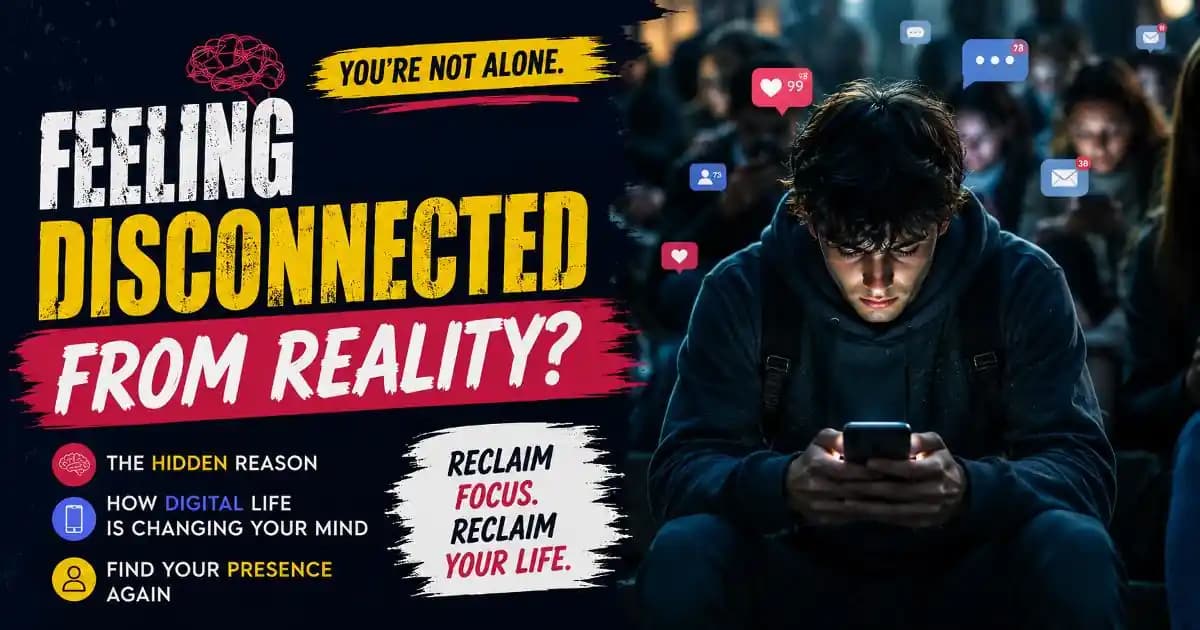
feeling disconnected from reality has quietly become part of everyday life for many people, even during moments that are supposed to feel meaningful.
Someone sits at dinner with friends but keeps checking their phone beneath the table. A person walks through a beautiful city while mentally narrating how the moment might look online later. Another spends hours scrolling through emotional videos, productivity clips, AI-generated content, relationship advice, memes, and news updates, only to realize at night they barely remember how the day actually felt.
The strange part is that many people are still functioning normally. They go to work. Reply to messages. Attend classes. Watch shows. Share photos. Keep conversations going. But internally, something feels slightly distant, fragmented, or emotionally blurred.
Real life sometimes feels less vivid than the constant stream of digital stimulation surrounding it.
This feeling is becoming increasingly common during 2025 and 2026, especially among people living inside highly connected digital environments. Not because people are weak or incapable of attention, but because modern internet culture has fundamentally changed how human attention, emotional processing, and presence operate.
Why feeling disconnected from reality often starts with attention fragmentation
Human attention was never designed for continuous interruption. Yet modern digital life depends on interruption almost everywhere.
Notifications appear during conversations. Short-form videos compete for emotional reactions every few seconds. Algorithms constantly predict what might keep someone engaged a little longer. Social feeds blend tragedy, humor, outrage, aspiration, beauty, loneliness, AI-generated fantasy, and advertising into one endless stream.
The human brain adapts to this rhythm surprisingly quickly.
Over time, many people stop experiencing attention as a stable state. Attention becomes fragmented into micro-moments. Thoughts become interrupted before they fully develop. Emotional reactions start occurring faster than emotional understanding.
This is one reason ordinary offline moments can begin to feel emotionally weaker than online experiences. Real life unfolds slowly. Algorithms do not.
Scrolling trains the brain to expect novelty, stimulation, and emotional shifts at unnatural speeds. Everyday reality cannot compete with a system designed to maximize engagement every few seconds.
That contrast slowly changes perception itself.
Digital overstimulation changes emotional presence in subtle ways
Most people associate overstimulation with stress or exhaustion. But digital overstimulation often creates something quieter and harder to describe.
It can produce emotional flattening.
When the nervous system constantly processes information, content, opinions, videos, messages, and notifications, emotional experiences begin overlapping too quickly. There is less psychological space between reactions.
A person might watch heartbreaking news, then a comedy clip, then productivity advice, then relationship drama, then AI-generated videos, then vacation photos from strangers all within minutes.
The brain rarely gets enough time to fully emotionally absorb any of it.
This creates a strange modern feeling where people are emotionally exposed to everything but deeply connected to very little.
Many people now describe experiences like:
“I know something mattered, but I didn’t really feel it.”
“I was there physically, but mentally somewhere else.”
“Life feels blurry lately.”
These feelings are not always signs of emotional failure. Often they reflect cognitive overload and attention exhaustion.
The attention economy rewards partial presence
One of the biggest internet culture shifts of the past decade is that platforms no longer compete simply for time. They compete for psychological immediacy.
Attention economy systems are designed to reduce pauses between stimulation and reaction. Infinite scrolling, autoplay, personalized recommendations, algorithmic feeds, push notifications, and AI-assisted content discovery all encourage continuous engagement.
In older forms of media, there were natural stopping points. Television programs ended. Websites required intentional searching. Social interaction had physical limits.
Now digital environments are intentionally frictionless.
The result is that many people spend large parts of the day only partially present everywhere. Half inside conversations. Half inside online feeds. Half inside imagined future interactions.
This partial presence accumulates psychologically.
People may start noticing:
difficulty sitting quietly without stimulation
reduced tolerance for boredom
attention span decline during offline activities
weaker emotional memory formation
constant low-level mental restlessness
Even joyful experiences sometimes feel strangely interrupted because part of the brain remains conditioned to anticipate the next digital input.
Online validation culture quietly reshaped emotional identity
Online validation culture also changed how many people emotionally experience reality itself.
For years, digital platforms gradually trained users to interpret moments through visibility, engagement, and presentation. Experiences increasingly became connected to how they might appear online.
This does not mean people are fake. It means social behavior adapted to platform environments.
Someone attends a concert while mentally documenting it. A vacation becomes partially filtered through future posting decisions. Even emotional reactions sometimes become performative because internet culture rewards visible expression.
Over time, this can create subtle emotional distance from direct experience.
Instead of fully inhabiting moments, people sometimes observe themselves having moments.
That psychological split contributes to why many people describe modern life as feeling strangely unreal despite constant activity.
The internet did not invent validation-seeking behavior. Humans have always cared about social recognition. But digital systems amplified it continuously and algorithmically.
Now validation can arrive instantly through likes, replies, reposts, metrics, views, and reactions. The brain begins associating emotional significance with visibility.
Quiet experiences without digital acknowledgment may start feeling emotionally less substantial, even when they are personally meaningful.
Parasocial behavior changed emotional energy online
Parasocial behavior has also become deeply normalized.
Many people now spend hours emotionally engaging with creators, streamers, influencers, AI personalities, podcasts, internet communities, and online figures they will never actually meet.
These interactions are not inherently unhealthy. Some provide genuine comfort, education, humor, or companionship.
But they still affect emotional attention.
The human brain often processes repeated exposure as a form of familiarity. Emotional energy gets distributed across hundreds of digital relationships, personalities, and narratives.
At the same time, many people spend less uninterrupted time in slow in-person connection.
This imbalance can create an emotionally confusing experience where someone feels socially saturated online while simultaneously feeling lonely offline.
The brain remains busy socially, but emotional grounding weakens.
Smartphone dependency affects how people experience ordinary life
Smartphone dependency is not always dramatic addiction. Often it appears as automatic emotional reflex.
Moments of silence immediately trigger checking behavior. Waiting becomes scrolling. Discomfort becomes distraction. Boredom becomes content consumption.
Phones increasingly function as emotional regulation tools.
People reach for devices during:
awkwardness
uncertainty
loneliness
stress
fatigue
emotional discomfort
But constant emotional avoidance reduces opportunities for psychological processing.
Older forms of boredom once created reflection, imagination, observation, and internal dialogue. Continuous stimulation reduces those mental spaces.
That is partly why some people now struggle to feel emotionally anchored in quiet offline environments. The nervous system becomes accustomed to constant input.
The human attention crisis is also an emotional crisis
The phrase human attention crisis sounds abstract until it becomes personal.
Someone forgets what they read moments earlier. Conversations become harder to stay inside fully. Movies require second-screen scrolling. Emotional reactions feel immediate but shallow. Life moves quickly yet feels strangely unprocessed.
Many people are not only tired physically. They are mentally overexposed.
The emotional consequences are subtle:
persistent mental noise
difficulty feeling grounded
reduced emotional clarity
constant comparison
identity confusion
Digital life exposes people to more identities, lifestyles, opinions, aspirations, and emotional stimuli than any previous generation experienced daily.
The nervous system is still adapting to that reality.
AI-generated content is making reality feel even more psychologically layered
The rise of AI-generated media adds another layer to modern emotional experience.
People now consume images, conversations, videos, music, writing, and personalities that may be partially synthetic, algorithmically optimized, or emotionally engineered.
This changes emotional trust online.
It also increases a strange feeling many people already carry: uncertainty about what feels emotionally authentic anymore.
As AI systems become integrated into search, entertainment, companionship apps, productivity tools, and creator platforms, the boundary between human interaction and algorithmic interaction becomes psychologically blurrier.
That does not mean human connection disappears. But it changes how people emotionally orient themselves inside digital spaces.
Digital mindfulness is becoming less about productivity and more about emotional recovery
Many people assume digital mindfulness means strict detoxes or abandoning technology completely. But for most people, the deeper issue is not technology itself. It is the loss of uninterrupted presence.
People increasingly miss the feeling of mentally arriving somewhere fully.
A conversation without checking notifications.
A walk without documenting it.
A meal without divided attention.
An evening without endless stimulation loops.
Modern life encourages constant connection, but human psychology still depends on moments of emotional stillness to feel grounded.
That is why small behavioral shifts sometimes feel emotionally powerful:
leaving the phone in another room
watching something without multitasking
allowing boredom briefly
spending time offline without broadcasting it
experiencing moments privately again
These actions are not about rejecting modern culture. They are about rebuilding emotional continuity.
Real life has not become less meaningful
One of the quiet fears many people carry is the feeling that they are somehow losing the ability to fully experience life emotionally.
But often the problem is not emotional emptiness itself. It is overstimulation competing with emotional attention.
Real life still moves at human speed.
Friendship still deepens slowly. Meaning still forms gradually. Emotional memory still depends on attention. Presence still requires mental space.
The difficulty is that modern digital systems increasingly condition people away from those slower emotional rhythms.
Understanding this changes the feeling itself.
Many people are not broken or emotionally detached beyond repair. They are psychologically overloaded by environments designed to continuously capture attention.
And beneath all the scrolling, notifications, AI-generated stimulation, and constant online presence, many people are simply trying to feel emotionally connected to their own lives again.