


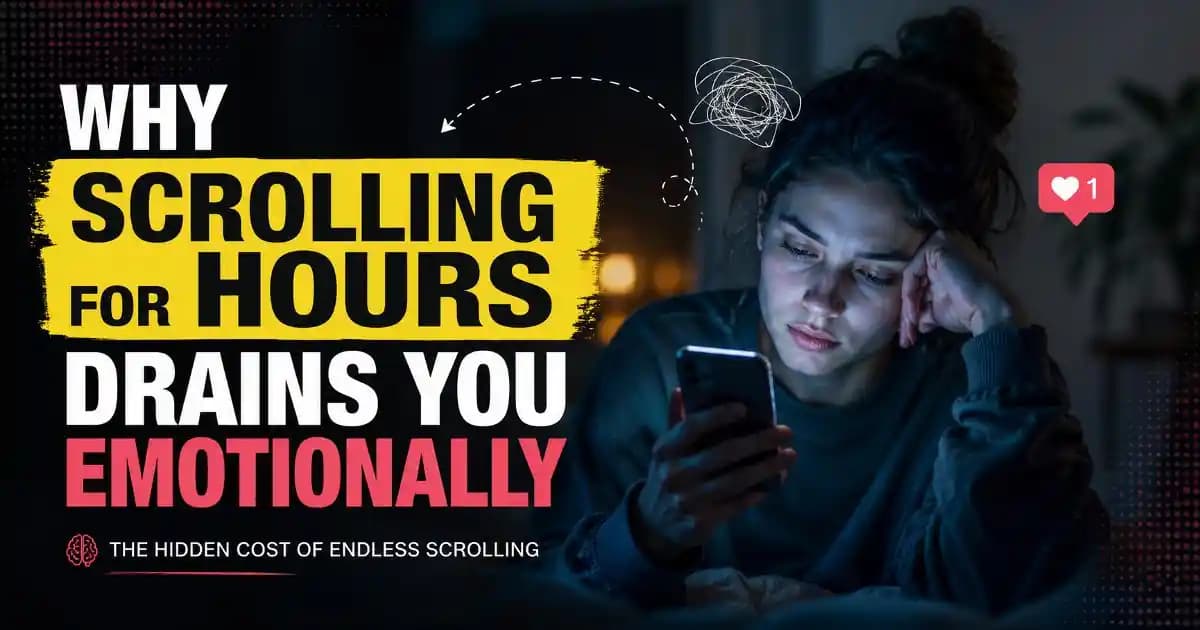
Emotional exhaustion from social media often doesn’t feel dramatic at first. It feels small. You close an app after scrolling for two hours and suddenly everything feels heavier than it should. Your brain feels noisy, your emotions feel strangely flat, and even simple conversations start feeling mentally expensive.
A lot of people notice this late at night. They pick up their phone for “just a few minutes,” move through endless videos, opinions, updates, outrage, relationship content, AI-generated images, productivity advice, political tension, lifestyle envy, and algorithmically optimized emotions then eventually look up feeling emotionally overstimulated but somehow emotionally empty at the same time.
That contradiction is becoming one of the defining emotional experiences of digital life in 2025 and 2026.
People are consuming more emotional input than ever before, but processing very little of it fully. Modern scrolling culture keeps the nervous system active for hours without offering genuine emotional resolution. The result is a form of quiet psychological fatigue that many people struggle to explain.
Why scrolling drains people emotionally now
Social media used to feel more social. Now it often feels like an endless emotional feed powered by algorithms competing for attention.
Every few seconds, the brain is asked to emotionally adjust.
One post triggers comparison. The next triggers anxiety. Then nostalgia. Then outrage. Then loneliness. Then aspiration. Then fear about the future. Then a funny video briefly resets the emotional tension before the cycle starts again.
Human emotions were never designed to switch contexts this quickly for hours at a time.
Most people assume emotional exhaustion only comes from difficult life events or overwork. But attention itself requires emotional energy. Constant digital stimulation slowly depletes that energy even when someone is physically resting.
This is why people can spend an entire evening “doing nothing” online and still wake up mentally tired.
The exhaustion is not just cognitive. It is emotional. The brain keeps reacting, comparing, filtering, interpreting, and adapting to an overwhelming amount of social information.
The attention economy quietly trains emotional instability
The modern attention economy rewards emotional intensity because strong emotions keep people engaged longer.
Algorithms have become extremely effective at learning what emotionally activates users. Not necessarily what helps them feel grounded or psychologically healthy but what keeps them scrolling.
That changes how people emotionally experience the internet.
Many platforms now create an environment where emotional regulation becomes harder over time. Calm attention struggles to survive inside systems optimized for urgency, novelty, and emotional spikes.
People often leave social media feeling emotionally fragmented because their minds never settle into one emotional state long enough to process it naturally.
This is also why digital overstimulation can create emotional numbness. After hours of continuous emotional input, the nervous system sometimes stops reacting fully as a form of self-protection.
Ironically, this emotional flattening can push people to scroll even more because they are unconsciously searching for stimulation strong enough to feel emotionally real again.
Why social comparison feels more exhausting now
Social comparison has always existed, but algorithmic culture intensifies it in subtle ways.
People no longer compare themselves only to celebrities or distant public figures. They now compare themselves to carefully edited versions of ordinary people all day long.
Someone else’s relationship. Someone’s productivity routine. Someone’s skincare transformation. Someone’s remote-work lifestyle. Someone’s emotional healing journey. Someone’s AI-powered side hustle success.
Even when people logically understand that online content is curated, the emotional brain still absorbs repeated comparison signals.
Over time, this creates a low-grade emotional pressure that many people carry without realizing it.
People start feeling behind in life without clearly knowing why.
They feel emotionally inadequate even when nothing is objectively wrong.
This constant comparison fatigue contributes heavily to emotional burnout, especially among younger users who grew up inside highly visual algorithmic ecosystems.
The strange loneliness of constant connection
One of the most psychologically confusing parts of modern digital life is how connected people can feel socially while still feeling emotionally isolated.
Many people spend hours interacting with content but very little time experiencing emotionally present connection.
Reaction-based communication slowly replaces deeper emotional interaction. People send memes, react to stories, share short videos, or exchange fragmented messages throughout the day, but many rarely feel fully emotionally seen.
This creates a subtle form of modern loneliness that feels difficult to explain because technically people are communicating all the time.
But emotional connection and digital interaction are not the same thing.
Scrolling can sometimes simulate social participation while quietly reducing emotional fulfillment.
That emotional gap often becomes more visible late at night, when the distraction slows down and people suddenly notice how emotionally drained they actually feel.
AI-generated culture is increasing emotional fatigue
The rise of AI-generated content is also changing how people emotionally experience the internet.
People now move through feeds filled with synthetic images, AI influencers, hyper-optimized content, automated emotional hooks, artificial intimacy, and increasingly polished digital personas.
The emotional brain still reacts to these experiences even when people intellectually know some of the content is artificially generated.
This creates a strange psychological environment where emotional authenticity becomes harder to identify.
Many users are starting to feel emotionally skeptical online. They consume huge amounts of content while trusting less of what they see.
That emotional distrust creates another form of mental fatigue.
The internet increasingly demands emotional attention while offering less emotional certainty.
Why people keep scrolling even when it makes them feel worse
One of the most misunderstood parts of scrolling behavior is that emotional exhaustion itself can increase compulsive scrolling.
When people feel emotionally depleted, they often look for low-effort forms of relief. Endless scrolling provides constant stimulation without requiring much emotional vulnerability or physical effort.
For a brief moment, distraction feels easier than emotional stillness.
But emotionally avoidant scrolling rarely creates genuine recovery.
Instead, it often extends emotional fatigue because the brain never fully rests.
This is why people sometimes finish long scrolling sessions feeling strangely disconnected from themselves. Their attention has been externally directed for so long that internal emotional awareness becomes temporarily muted.
Modern apps are extremely good at preventing psychological stopping points. Infinite feeds remove natural endings, making emotional disengagement harder than it used to be.
The body often notices emotional overload before the mind does
Many people recognize emotional exhaustion physically before they recognize it emotionally.
They notice headaches, mental fog, difficulty concentrating, emotional irritability, shallow sleep, restless attention, or an inability to feel mentally calm without constant stimulation.
Some people feel emotionally detached from real-life experiences after spending too much time online. Others notice that offline conversations start feeling slower or less stimulating compared to algorithmic content feeds.
This does not mean people are “broken” or incapable of attention.
It reflects how deeply modern digital behavior reshapes emotional rhythms over time.
The human nervous system adapts to repeated environments. When someone spends years inside fast-moving digital ecosystems, slower emotional experiences can begin to feel unfamiliar.
Emotional recovery now requires intentional quiet
One reason emotional recovery feels harder today is because modern life leaves very little room for uninterrupted mental stillness.
People move from work notifications to social feeds to streaming platforms to AI tools without many genuine psychological pauses in between.
Even relaxation is increasingly consumed through screens.
As a result, many people rarely experience emotional silence long enough for the nervous system to reset naturally.
That is partly why activities like walking without headphones, spending time offline, slow conversations, journaling, reading quietly, or sitting without constant stimulation are starting to feel emotionally restorative again.
These moments reduce attention fragmentation and allow emotional processing to catch up.
People often describe this as finally being able to “hear themselves think” again.
Modern emotional exhaustion is deeply connected to digital life
The growing emotional exhaustion many people feel after scrolling for hours is not simply about weak self-control or spending “too much time online.”
It reflects a deeper shift in how human attention, identity, emotion, and social life now interact with technology.
Modern internet culture constantly pulls emotional energy outward. It asks people to react continuously, compare continuously, consume continuously, and remain emotionally available to an endless stream of information.
Eventually, many people begin feeling emotionally overloaded without fully understanding why.
The important thing is recognizing that this feeling is increasingly common and understandable.
Human beings still need emotional rest, emotional clarity, meaningful connection, and moments of psychological stillness, even inside an always-online world.
And sometimes the first step toward feeling emotionally better is simply recognizing that endless scrolling is affecting the nervous system more deeply than people were ever taught to notice.