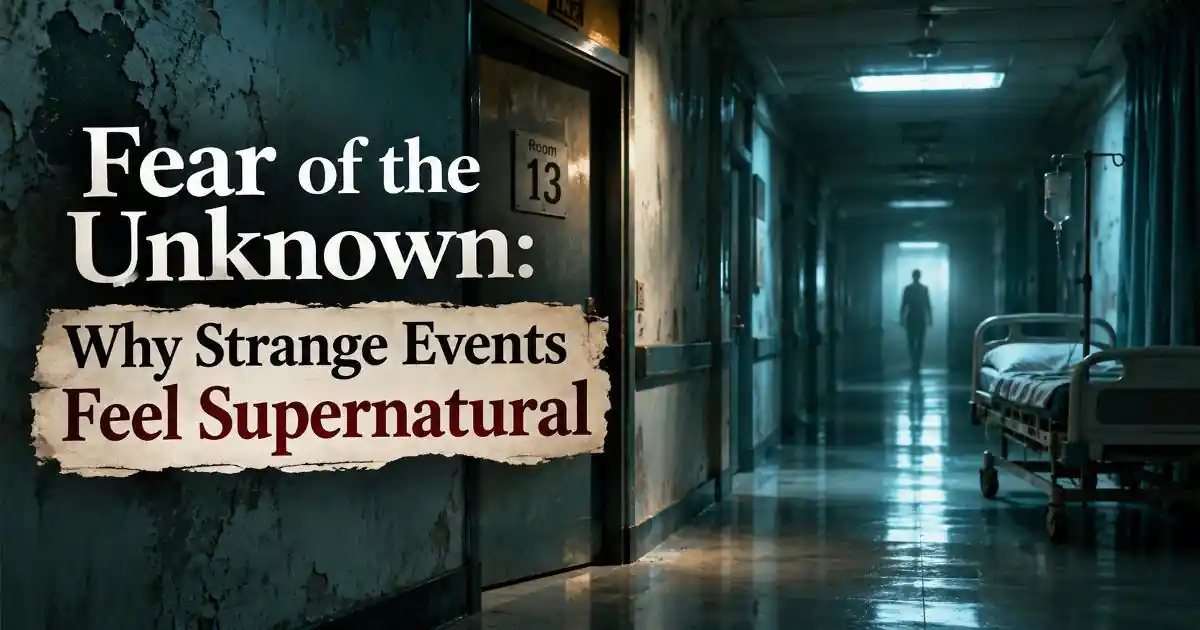
A fear of the unknown can make an ordinary sound feel threatening, an unfamiliar shadow seem alive, or an unexplained experience stay in someone's memory for years. When people encounter something they cannot immediately understand, the mind does not always remain neutral. It searches for an explanation, often drawing on memories, beliefs, emotions, and the surrounding environment.
Consider the stories that circulate about abandoned hospital corridors, empty rooms, strange noises, and patients who believe they have seen someone who was not supposed to be there. Some accounts describe supernatural encounters. Others eventually turn out to involve ordinary human behavior that was hidden, misunderstood, or initially overlooked. What makes these stories so unsettling is not simply the possibility of something unexplained. It is the uncertainty surrounding what actually happened.
Two hospital stories in a recent horror narration illustrate this contrast. One describes a security guard who allegedly encounters strange figures and unexplained sounds in an abandoned section of a hospital. Another describes women who report frightening experiences in a maternity ward, with the narration eventually presenting a human perpetrator rather than a supernatural explanation. These are stories told in a video, not independently established evidence. But the contrast offers a useful starting point for understanding fear, perception, and human vulnerability.
Why fear of the unknown feels so powerful
People generally feel more comfortable when they understand their surroundings. Familiar environments provide a sense of predictability. We know what a normal sound means, what to expect from a particular room, and how to respond to everyday situations.
Uncertainty interrupts that sense of control. A noise coming from an empty corridor is more unsettling when nobody can explain it. A shadow becomes more frightening when the person looking at it cannot identify its source. The mind begins considering possibilities, even when there is not enough information to reach a reliable conclusion.
This is one reason unfamiliar environments can feel threatening. The absence of a clear explanation leaves room for imagination. Fear does not necessarily mean that something dangerous is present. It can also mean that the brain is trying to prepare for a possibility it cannot evaluate properly.
In a hospital, this response can become particularly intense. Hospitals are associated with illness, vulnerability, loss, and uncertainty. An empty ward or an unfamiliar medical environment can carry emotional associations that make an ordinary disturbance feel much more significant.
How the mind turns unexplained experiences into stories
Human beings naturally look for patterns. We connect events, remember unusual details, and try to understand why something happened. This ability helps us navigate everyday life, but it can also lead us to connect details that do not necessarily belong together.
Imagine hearing a metallic sound in an empty building. You might initially assume that a door moved, equipment shifted, or someone is working nearby. But if you have already heard stories about the building being haunted, your interpretation may change. The same sound can suddenly feel like evidence of something frightening.
This does not mean that people are deliberately inventing experiences. A person can genuinely hear a sound, see something briefly, or feel threatened without correctly understanding its cause. The experience and the explanation are two different things.
Memory also plays a role. When people repeatedly retell frightening experiences, certain details can become more prominent. A vague noise may become a mysterious movement. A brief glimpse may become a clearly remembered figure. This is one reason stories can become more dramatic as they circulate between people.
Why vulnerable moments can make fear more intense
The second hospital story in the narration introduces a different kind of vulnerability. It describes women recovering after childbirth who report being approached or attacked by someone they could not initially identify. The narration eventually presents the alleged perpetrator as a real person who used a disguise to avoid recognition.
Whether or not every detail in the account is accurate, the underlying human issue deserves attention: people can be especially vulnerable when they are physically exhausted, recovering from a medical procedure, or dependent on others for their safety.
In these situations, a person may struggle to understand what is happening or respond immediately. Confusion, fear, physical weakness, and the unfamiliar surroundings can make an already distressing experience even harder to process.
There is an important distinction here. An experience that sounds unbelievable does not automatically mean that the person reporting it is imagining things. At the same time, an unusual experience should not automatically be interpreted as supernatural. Both assumptions can prevent people from investigating what actually happened.
When people dismiss fear instead of understanding it
One of the most troubling themes in the hospital narration is the response of people who initially question the accounts of those reporting frightening experiences. In the second story, the first reports are allegedly attributed to the effects of medication or exhaustion.
There can be legitimate medical reasons to consider confusion, medication effects, or altered perception after a procedure. But a medical explanation should be investigated carefully rather than used to dismiss a person's concerns without examination.
When someone reports feeling unsafe, the first response should be to take the concern seriously, establish immediate safety, and investigate the available evidence. This is particularly important in environments where patients depend on staff for protection.
Being heard does not require accepting every interpretation as fact. It requires separating what someone experienced from what they believe caused it. That distinction allows people to show compassion without abandoning critical thinking.
Why supernatural explanations become attractive
When an experience has no obvious explanation, supernatural interpretations can offer a complete narrative. A mysterious figure becomes a ghost. An unexplained sound becomes evidence of a presence. A series of unusual events becomes part of a larger story.
These explanations can feel emotionally satisfying because they give uncertainty a recognizable shape. Instead of accepting that something remains unexplained, people can attach it to an existing belief or cultural story.
Community influence matters too. When several people share similar stories about a location, the reputation of that place can shape how future visitors interpret their experiences. Someone entering an abandoned building after hearing frightening accounts may already be alert to every unusual sound and movement.
This is not a reason to ridicule people who believe in supernatural explanations. Beliefs are often connected to culture, personal experience, and family traditions. The more useful approach is to recognize the difference between personal belief, reported experience, and independently verified evidence.
How fear influences the way we remember an event
Fear can make certain moments feel unusually vivid. People may remember where they were standing, what they heard, or how their body reacted. Yet a vivid memory is not necessarily a complete or perfectly accurate record of what happened.
During a frightening experience, attention can become concentrated on the perceived threat. Other details may receive less attention. Later, when someone tries to reconstruct the event, the mind may fill gaps using assumptions or information learned afterward.
This helps explain why two people can remember the same incident differently. It also explains why repeated storytelling can gradually change how an event is described.
Understanding this does not mean that memories should be dismissed. It means that we should approach frightening accounts with empathy while remaining careful about conclusions.
The difference between believing someone and accepting every explanation
There is a valuable lesson in the contrast between the two hospital stories. The first is presented as a possible supernatural encounter. The second initially appears mysterious but eventually becomes a story about alleged criminal behavior.
Both illustrate how uncertainty can influence the way people interpret events. However, they also highlight why explanations should be examined rather than accepted simply because they sound convincing.
When someone describes a frightening experience, we can acknowledge their fear without immediately agreeing with their interpretation. We can ask what happened, what evidence exists, whether other explanations are possible, and whether anyone remains at risk.
This balance is important in everyday life, too. Rumours, frightening videos, online discussions, and emotionally charged stories can influence our beliefs before we have enough information to judge them. The internet makes it especially easy for an unexplained incident to become a widely shared narrative.
Learning to live with uncertainty without letting fear take over
Not every unusual experience has an immediate explanation. Sometimes information is incomplete. Sometimes memories are uncertain. Sometimes an incident requires proper investigation before anyone can understand what happened.
Developing emotional awareness means recognizing when fear is influencing our interpretation of a situation. It means giving ourselves time to distinguish an observation from an assumption and a genuine safety concern from an imagined possibility.
It also means taking other people's experiences seriously without allowing rumours to replace evidence. If someone reports a possible threat, practical safety and appropriate investigation should come before speculation.
Perhaps the most unsettling part of stories about unexplained events is not always the possibility of something supernatural. It is the reminder that human beings do not always know what is happening around them, especially when they are frightened or vulnerable.
We may never have an immediate answer to every strange experience. But we can choose how we respond to uncertainty. We can remain curious without becoming careless, compassionate without abandoning judgment, and cautious without allowing fear to control every interpretation.
Sometimes the most important question is not whether something was a ghost. It is whether we took the experience seriously enough to understand what really happened.
Frequently Asked Questions