


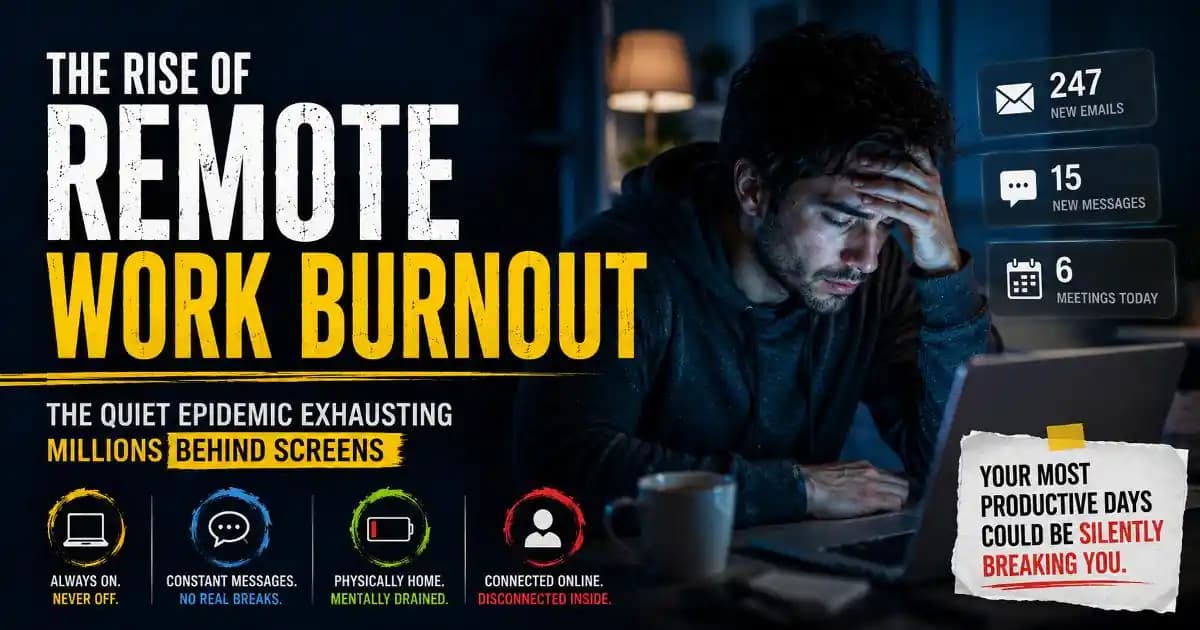
Remote work burnout often does not look dramatic anymore. Many people still complete tasks, attend meetings, answer messages, and appear productive on the surface. But underneath daily routines, a quieter kind of exhaustion has started spreading through modern work culture.
Someone closes a laptop at night yet still feels mentally connected to work hours later. Another person spends the entire day online speaking to coworkers through screens while privately feeling emotionally isolated. Someone else notices they are always technically working, even during moments meant for rest.
The exhaustion builds slowly.
Not through one overwhelming crisis, but through constant low-level emotional pressure that never fully stops.
For many people, remote work promised freedom, flexibility, and better balance. In some ways, it delivered those things. But it also quietly erased many psychological boundaries human beings once depended on to recover emotionally from work.
And increasingly, many workers are beginning to realize that being physically at home does not automatically mean the nervous system feels rested.
Why remote work changed emotional recovery
Before remote work became deeply normalized, work and personal life usually contained more physical separation.
People left offices. Conversations ended naturally. Commuting created psychological transition time. Workspaces stayed in specific locations instead of following people everywhere.
Remote work disrupted many of those emotional boundaries.
Now work often exists inside bedrooms, kitchens, living rooms, and private emotional spaces. Notifications continue long after official work hours end. Conversations move across email, Slack, messaging apps, video calls, and collaborative platforms continuously.
The nervous system rarely feels fully “off.”
Even moments of rest can contain low-level anticipation that another task, notification, or message may appear at any time.
That ongoing psychological openness gradually drains emotional energy.
Quiet burnout often hides behind productivity
One reason remote work burnout feels difficult to identify is because many people remain outwardly functional while internally exhausted.
They still meet deadlines. They still respond professionally. They still appear organized online.
But internally, many workers quietly notice symptoms like emotional numbness, attention fatigue, mental fog, irritability, sleep disruption, difficulty concentrating, emotional detachment, or a strange inability to fully relax.
This exhaustion often becomes invisible because remote work culture normalized constant digital engagement as ordinary behavior.
People spend entire days switching between meetings, notifications, tabs, messages, collaborative tools, AI-assisted workflows, and endless online communication without enough genuine mental stillness in between.
The emotional brain remains continuously active.
Eventually, some people stop feeling dramatically stressed and instead begin feeling emotionally flat.
That emotional flattening is becoming one of the defining signs of quiet burnout.
The attention economy entered the workplace
Modern remote work increasingly overlaps with the attention economy itself.
Work no longer happens inside isolated professional environments. It happens through the same digital systems already competing heavily for attention outside work hours.
Employees move between productivity platforms, social media, AI tools, messaging apps, creator content, emails, dashboards, and notifications all day long.
The brain rarely experiences uninterrupted focus.
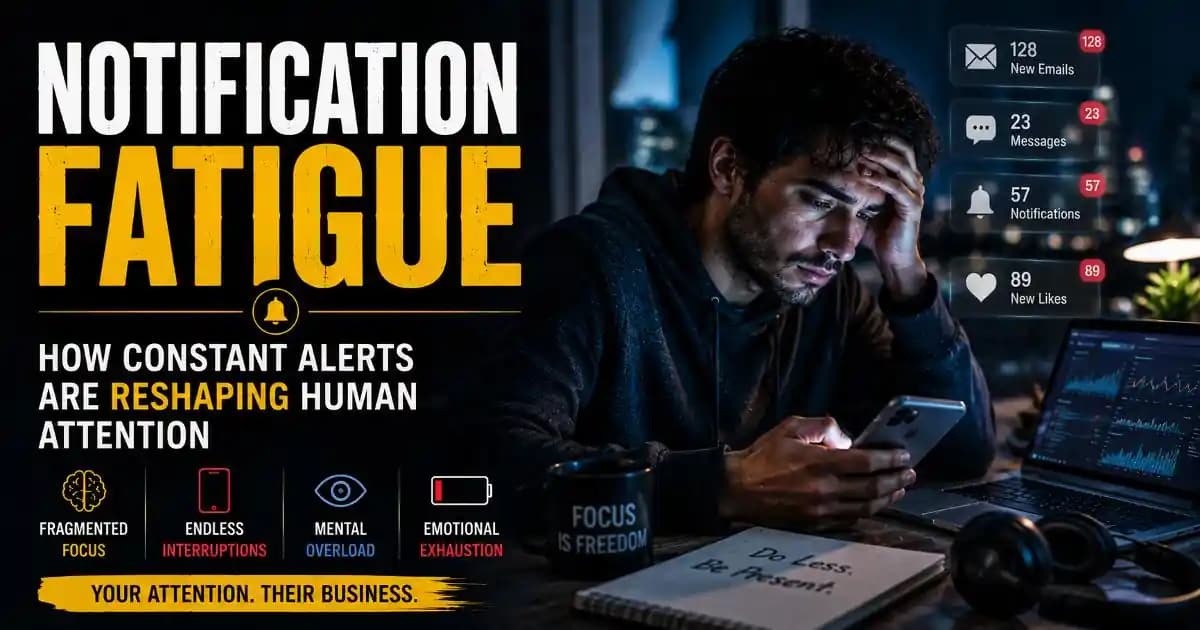
Instead, attention becomes fragmented across dozens of digital interruptions continuously.
This fragmentation creates a strange psychological state where people can feel mentally overstimulated while simultaneously feeling emotionally disconnected from meaningful work.
Many remote workers quietly describe feeling “always busy but never fully present.”
That contradiction reflects how deeply digital work culture reshaped human attention itself.
Why remote workers feel emotionally isolated even when constantly connected
Remote work also changed social connection in ways many people underestimated initially.
Technically, communication became easier than ever. Meetings happen instantly. Messages arrive constantly. Collaboration continues all day across digital platforms.
But emotional connection often became thinner.
Many workers now spend entire weeks interacting through screens while rarely experiencing sustained in-person presence, casual human interaction, spontaneous conversation, or emotionally grounding workplace relationships.
Video calls create communication, but not always emotional closeness.
Digital collaboration often prioritizes efficiency over emotional depth.
As a result, many people quietly feel socially connected while emotionally isolated at the same time.
This emotional isolation contributes heavily to remote work burnout because human beings still psychologically need moments of genuine presence, shared energy, and emotional familiarity with others.
The culture of constant availability intensified burnout
Remote work also normalized permanent accessibility in ways earlier work cultures often could not.
Many employees now feel subtle pressure to remain reachable throughout the day and sometimes beyond official hours.
Online status indicators, instant messaging systems, rapid-response expectations, and global digital workflows created environments where silence can feel emotionally risky.
People worry about appearing unproductive, unavailable, or disconnected if they do not respond quickly enough.
This creates low-level psychological vigilance that continues even during downtime.
For many remote workers, the mind never fully stops monitoring work-related possibility.
That constant emotional readiness slowly exhausts the nervous system.
AI-powered productivity culture is accelerating emotional exhaustion
The rise of AI-powered work systems is intensifying remote work burnout in more subtle ways.
AI tools improve efficiency, automate repetitive tasks, accelerate communication, and increase output speed. But emotionally, they also shift expectations.
When workflows become faster, people often feel pressure to operate faster psychologically too.
Many remote workers quietly feel they should always be learning new systems, producing more output, adapting continuously, and staying professionally competitive in rapidly changing digital environments.
This creates a persistent feeling of never fully catching up.
Even highly capable individuals increasingly feel mentally behind despite working constantly.
The emotional pressure is no longer only about workload. It is about trying to emotionally adapt to systems that rarely pause.
Why working from home can make emotional boundaries weaker
One of the deepest psychological effects of remote work is that personal environments now absorb work stress directly.
Historically, home often functioned as emotional separation from professional identity. Now those spaces overlap constantly.
A dining table becomes a workstation. A bedroom becomes an office. A couch becomes a meeting space.
The nervous system stops associating home entirely with recovery because work presence remains psychologically embedded inside private life.
Some remote workers quietly notice they no longer feel fully relaxed anywhere because work mentally follows them through every environment.
This emotional blending weakens recovery cycles over time.
Many people feel guilty for being burned out remotely
Another reason quiet burnout spreads so widely is because many remote workers feel they should not complain.
Working from home often appears more comfortable than physically demanding jobs or long commutes. Some people feel guilty admitting emotional exhaustion because they technically have more flexibility.
But emotional burnout is not determined only by physical difficulty.
Psychological strain matters too.
Constant digital engagement, emotional isolation, fragmented attention, blurred identity boundaries, nonstop communication, and permanent accessibility create real emotional fatigue even when someone is physically sitting at home.
Many remote workers are not exhausted because they are weak or incapable. They are emotionally adapting to environments that continuously demand attention without enough separation or recovery.
Why people increasingly crave slower work rhythms
As quiet burnout spreads, many people are beginning to realize they miss older emotional rhythms more than they expected.
They miss clear endings to workdays. Conversations that feel less transactional. Offline thinking time. Uninterrupted focus. Emotional spaciousness. Moments where attention no longer belongs to screens constantly.
This helps explain why more individuals are becoming emotionally drawn toward slower routines, digital boundaries, flexible offline time, and work cultures that prioritize psychological sustainability instead of endless optimization.
The deeper conversation around remote work burnout is not simply about productivity or efficiency.
It is about whether modern digital work culture still leaves enough room for human emotional recovery.
And increasingly, many people are beginning to recognize that sustainable work may depend less on staying constantly available and more on protecting the emotional boundaries that allow the nervous system to feel fully human again.